Key Facts
- In Group H, all four teams have one point; a win would allow Uruguay and Cape Verde to pull ahead of the competition early on.
- Uruguay was held to a 1-1 draw against Saudi Arabia; Maxi Araújo’s late equalizer did not mask the lack of chemistry between Valverde, Bentancur, and Núñez.
- Cape Verde confirmed its defensive solidity in the 0–0 draw against Spain; Vozinha’s seven saves were what really highlighted the team’s compact approach.
- Uruguay must replace Ronald Araujo due to a muscle injury, and Giorgian de Arrascaeta’s absence weakens the creative midfield behind Darwin Núñez.
- Since there are no previous head-to-head matches, current trends are particularly important: Uruguay’s faltering rhythm faces off against Cape Verde’s resilience under pressure.
- The case for under 2.5 goals is supported by Uruguay’s offense, which has averaged just 0.6 goals per game over the last five matches, plus Cape Verde’s patience.
Vozinha’s seven saves against Spain have freshly cemented Cape Verde’s most memorable upset of the tournament so far in everyone’s memory: a 0–0 draw, fueled by a compact defensive strategy and a lot of composure under pressure. All four teams have one point; Uruguay is ahead of Saudi Arabia only due to the current standings, while Cape Verde is tied with Spain. The data provided does not include a head-to-head record, which gives the match a clean tactical starting point rather than the context of a long-standing rivalry.
- Venue: Hard Rock Stadium, Miami
- Date and Time: June 22, 2026, 12:00 a.m.
- Competition: World Cup (Group Stage – 2)
The “Draw – 1st Half” bet aligns with Uruguay’s slow starts and Cape Verde’s discipline, while the “Under 2.5 Goals” market is further supported by Uruguay’s recently lackluster attack. With Giorgian de Arrascaeta questionable and Vozinha suddenly taking on a central role following his performance against Spain, the Cape Verde +0.5 handicap certainly has underdog appeal.
Uruguay Form & Record Check
Uruguay’s 1-1 draw against Saudi Arabia was more bumpy than disastrous, but it extended a streak across all competitions in which Bielsa’s team has drawn far more often than it has truly controlled matches.
Maxi Araújo saved a point late in the game, yet the performance still looked like that of a team still searching for smoother connections between Federico Valverde, Rodrigo Bentancur, and Darwin Núñez. The broader record tells the same story: Uruguay drew 0–0 with Algeria, 1–1 with England, and 0–0 with Mexico, with a heavy 5–1 loss to the U.S. in between. So their offensive potential hasn’t yet lived up to the squad’s reputation, and with Ronald Araujo and Giorgian de Arrascaeta questionable due to muscle injuries, defensive aggression and creativity in the midfield could suffer.
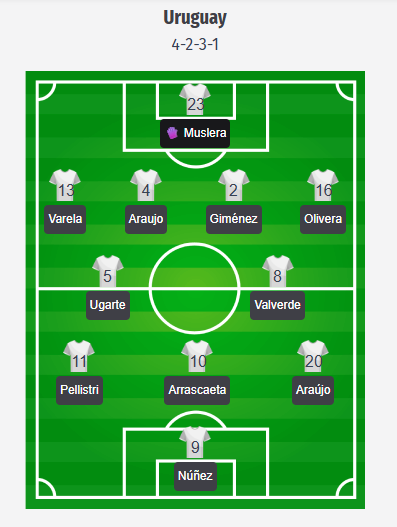
Uruguay could line up in an expected 4-2-3-1 formation, with Fernando Muslera (No. 23) in goal and José María Giménez (No. 2) anchoring the defense. With Ronald Araujo (No. 4) out due to a muscle injury, Sebastián Cáceres appears to be the obvious replacement. Manuel Ugarte (No. 5) and Federico Valverde (No. 8) are expected to form the backbone of the midfield, while Darwin Núñez (No. 9) leads the attack. Giorgian de Arrascaeta (No. 10) is also out, which is likely to open up a spot for Nicolás de la Cruz.
Cape Verde Form & Record Check
Cape Verde’s 0-0 draw against Spain wasn’t just a lucky fluke for a debutant, even if Vozinha’s seven saves made the headlines. Bubista’s team defended compactly, shut down the central lanes, and posed enough of a threat on set pieces for Diney Borges to draw attention late in the game. Sidny Lopes Cabral embraces the underdog role rather than shying away from it. Their broader form across all competitions also lends substance to the optimism: Before facing Atlanta, they beat Bermuda 3–0 and Serbia 3–0 in friendlies, then narrowly advanced in the FIFA Series after a 1–1 draw with Finland, while the 4–2 win over Chile showed just how dangerous they can be when the game opens up. Against Uruguay, the priority should be to keep the match close for as long as possible.
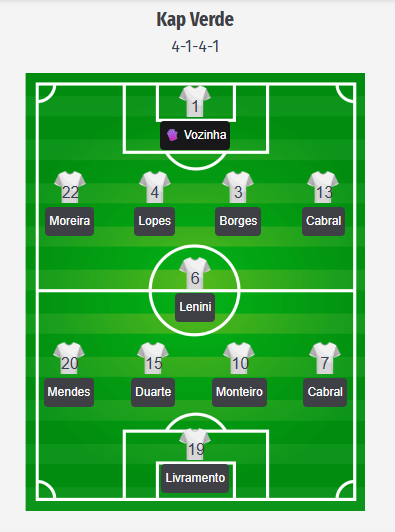
Cape Verde could stick with a 4-1-4-1 formation, with Vozinha back in goal following his standout performance against Spain. Roberto Lopes and Diney Borges are expected to stabilize the central defense, while Kevin Lenini will likely provide cover in front of the back line. Jamiro Monteiro can link up with the attack, with Ryan Mendes and Jovane Cabral supporting Dailon Livramento up front. No injuries have been reported.
Uruguay vs. Cape Verde Head-to-Head & Statistics
The available data does not include any previous matches between Uruguay and Cape Verde, so there is no reliable pattern in their head-to-head record. That is precisely why their recent tournament performances are so important: Uruguay’s faltering rhythm will face off against Cape Verde’s proven ability to withstand periods of pressure without losing their composure.