Key Facts
- Scotland leads Group C with three points after a 0-1 victory over Haiti; Morocco is within striking distance with one point following a 1-1 draw against Brazil.
- John McGinn sealed Scotland’s opening match, but nervousness and caution remained evident; Ben Gannon-Doak’s pace provides a crucial outlet from a deep defensive block.
- Morocco’s 1-1 draw against Brazil looked well-organized: Ismael Saibari scored off an assist from Brahim Díaz, while Ayyoub Bouaddi provided stability in midfield.
- Scotland reports no new injury concerns; Scott McKenna is working on his comeback; Steve Clarke can plan Scotland’s familiar 3-4-2-1 formation without any forced changes.
- Since there are no reliable head-to-head records, current factors carry more weight: Scotland’s tournament performance, Morocco’s recent unbeaten streak, and control in midfield.
- Scotland’s recent games have shown a decreasing offensive output, which is why “Both Teams to Score: No” at 1.80 is a statistically better bet than goal-based wagers.
Boston has clearly embraced Scotland, and when Steve Clarke’s team returns to Gillette Stadium on Saturday night, there will be something tangible behind the chants this time. The 0-1 victory over Haiti was more of a nail-biter than a clean win, but it propelled Scotland to the top of Group C. Morocco, under Mohamed Ouahbi, is coming off a composed 1-1 draw against Brazil—a result that felt less like a surprise and more like a testament to their own quality. The gap in the group is small but significant: Scotland has three points, Morocco has one, and Brazil is tied with Morocco.
- Venue: Gillette Stadium, Boston
- Date and time: June 20, 2026, 12:00 a.m.
- Competition: World Cup (Group Stage – 2)
Scotland’s narrow opening match, their recent streak of clean sheets, and the home advantage in Boston all point toward Under 1.5 goals and “Both Teams to Score: No,” while Morocco’s disciplined performance against Brazil keeps the threat high. It’s precisely this tension that also makes 1X at around 2.3 a serious long shot.
Scotland Form & Record Check
Scotland’s opener was valuable precisely because it wasn’t flawless. John McGinn provided the decisive moment against Haiti, while Scott McTominay had already posed a threat earlier in the match. Overall, the performance was marked by nervousness and long stretches of caution. Steven Naismith has since characterized the result as a foundation rather than a finished product, and that fits a team that still needs to find its rhythm in the tournament.
Across all competitions, the recent picture over the span of three games remains mixed: the 0-1 victory over Haiti followed a 0-4 loss in Bolivia and a 4-1 win over Curaçao, but the previous 0-1 defeats against Ivory Coast and Japan serve as a reminder of how harmless Scotland can appear when their transition opportunities are taken away. Clarke is therefore likely to prioritize shoring up the midfield first. Ben Gannon-Doak gives Scotland an outlet that changes the team’s options, as his pace can quickly create space from a deep block. Nevertheless, Morocco’s pressure in midfield could prompt Clarke to provide additional cover for John McGinn, Scott McTominay, and Lewis Ferguson. The likely starting lineup is therefore likely to prioritize balance over flair, especially since a point in Group C would be truly valuable.
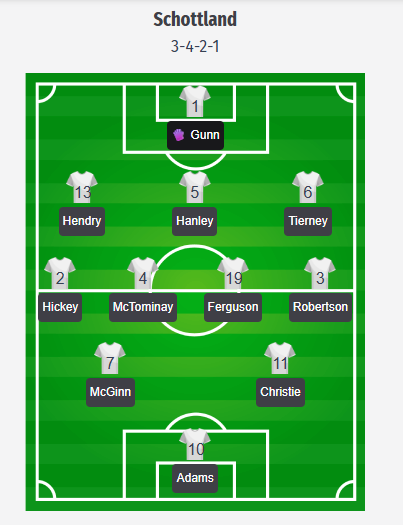
Steve Clarke could stick with Scotland’s expected 3-4-2-1 formation, with Angus Gunn in goal behind Jack Hendry (13), Grant Hanley (5), and Kieran Tierney (6). This back three would give the team its familiar tournament framework. There are no new injury concerns, and Scott McKenna is on his way back after missing the match against Haiti. Therefore, no forced changes are expected. Scott McTominay (4) and Lewis Ferguson (19) could form the central midfield, with John McGinn (7) and Ryan Christie (11) playing close to Ché Adams (10).
Morocco Form & Record Check
Morocco’s 1-1 draw against Brazil wasn’t treated as a lucky escape in the football community. Ismael Saibari’s goal, set up by Brahim Díaz, gave Mohamed Ouahbi’s team early control, and their compact, physical structure forced Brazil into uncomfortable spells. The result drew even more attention from outside observers to Ayyoub Bouaddi, whose composure in midfield has already further fueled transfer rumors. Their overall form across all competitions looks more consistent than Scotland’s, even if two consecutive draws have dampened the mood somewhat. Morocco had drawn 1–1 with Norway following victories over Madagascar (4–0), Burundi (5–0), and Paraguay (2–1). In the available sample, the team has scored in every recent game, and their patterns after halftime suggest patience rather than nervousness. That patience will count against Scotland because, following the draw with Brazil, Morocco doesn’t need to chase a result. Achraf Hakimi and Noussair Mazraoui can stretch the field, while Sofyan Amrabat provides stability in midfield when the game gets scrappy. If Scotland sits deeper, Morocco’s task will be to move the ball quickly enough before the defensive block is set.
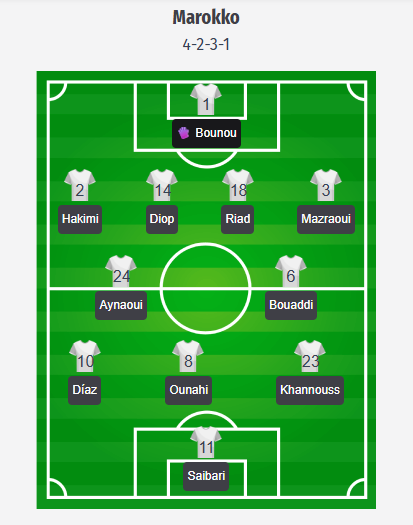
This prediction has Morocco playing a 4-2-3-1 formation, with Yassine Bounou in goal and a central defensive pairing of Issa Diop (14) and Chadi Riad (18). With no injuries reported for Morocco, Neil El Aynaoui (24) and Ayyoub Bouaddi (6) could anchor the midfield, while Brahim Díaz (10) and Ismael Saibari (11) provide firepower up front.
Scotland vs. Morocco Head-to-Head & Statistics
The available data for this matchup does not include any previous encounters between Scotland and Morocco, so there is no reliable pattern in their head-to-head record. This means the usual historical trends don’t apply, and the current situation takes on greater significance: Scotland’s tournament performance, Morocco’s recent unbeaten streak, and the tactical question of who controls the midfield.