Key Facts
- Australia advanced to the knockout stage thanks to defensive stability, but three scoreless games in their last five matches significantly limit their options.
- Egypt remained undefeated in the group stage and looks more dangerous offensively, as Mohamed Salah, Trezeguet, and Omar Marmoush make their presence felt in the final third.
- Australia has not conceded a goal after halftime in its last five matches, underscoring Popovic’s approach of discipline and patience.
- Egypt has scored in each of its last five matches but conceded goals in four of them—so Australia’s counterattacks remain a key factor.
- Based on the data, “Under 2.5 goals” seems like the logical choice, as Australia’s last five games averaged just 1.4 total goals and all finished under that mark.
- No injuries have been reported for either team, so any potential lineup changes are likely to be tactical rather than forced by absences.
Australia arrives in Arlington amid speculation surrounding Tony Popovic’s lineup decisions, after Mark Bosnich emphasized that changes were necessary for Friday’s Round of 32 Copa Mundial matchup at AT&T Stadium. Egypt, coached by Hossam Hassan, has looked more fluid in attack so far, while Australia has relied more on discipline, patience, and the willingness to endure extended periods without possession. The stakes are unusually clear: a spot in the Round of 16 and a potential matchup with Argentina or Cape Verde.
- Venue: AT&T Stadium, Dallas
- Date and Time: July 3, 2026, 8:00 p.m.
- Competition: World Cup (Round of 32)
The betting market sees Egypt as a slight favorite, but a draw is also considered a serious possibility, which fits the nature of this match well. Under 2.5 goals is the clearest data-driven approach, as Australia’s recent games have been controlled and low-scoring, while Egypt’s second halves have often been tight.
Australia Form & Record Check
Australia’s most recent match was a 0-0 draw against Paraguay, a result that secured their advancement but also highlighted the cost of Popovic’s approach. The Socceroos controlled the game well and conceded almost nothing after the break, but their attacking rhythm remained modest. Cristian Volpato started and was later replaced by Ajdin Hrustic, a substitution that is likely to factor into the debate over the starting lineup. Across all competitions, Australia’s last five results show resilience but little punch.
The team lost 0–2 to the U.S., beat Türkiye 2–0, drew 1–1 with Switzerland, and lost 0–1 to Mexico before the draw against Paraguay. Interestingly, Australia did not concede a goal after halftime during this stretch, which speaks to their discipline. However, failing to score in three of their last five matches leaves little room for error.
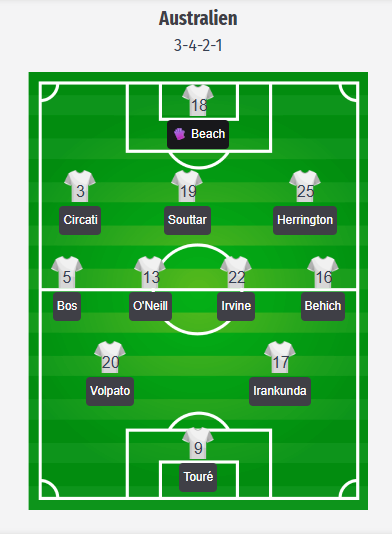
Australia could line up in a 3-4-2-1 formation, with Patrick Beach expected to start in goal behind Alessandro Circati, Harry Souttar, and Lucas Herrington. Aiden O’Neill and Jackson Irvine form the core of the midfield, while Cristian Volpato and Nestory Irankunda could support Mohamed Touré. Australia will have to do without Mathew Leckie (thigh) and Jacob Italiano (groin), who are both out with injuries; this limits their options on the wings and partly explains the lineup.
Egypt Form & Record Check
Egypt reached this round after a tense 1-1 draw against Iran, a match that got off to a fast start early on with a goal by Mahmoud Saber off an assist from Trezeguet but then became more complicated. Mohamed Abdelmonem had to come off early, Yasser Ibrahim came on, and later Hossam Hassan brought on Omar Marmoush and Zizo from the bench. The performance wasn’t flawless, but it was controlled enough to withstand the pressure. Their recent form across all competitions looks more convincing offensively than Australia’s. Egypt beat New Zealand 3–1, drew 1–1 with Belgium, lost 1–2 to Brazil, and won 1–0 against Russia before the draw with Iran. They scored in each of those five games, though the goals conceded in four of them show that Australia’s reliance on counterattacks isn’t just theory.
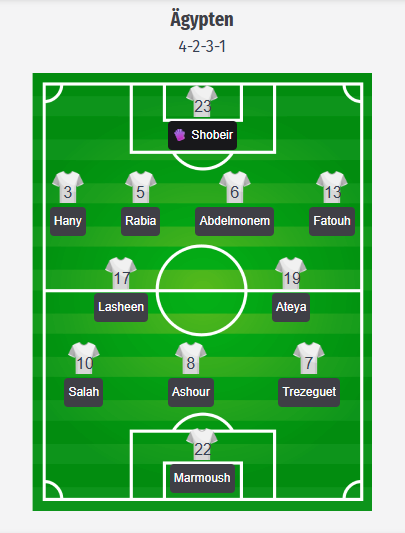
Egypt could line up in a 4-2-3-1 formation, with Oufa Shobeir 23 expected to start in goal. Ramy Rabia 5 and Mohamed Abdelmonem 6 are expected to form the central defensive pairing, with Mohanad Lasheen 17 and Marwan Ateya 19 anchoring the midfield in front of them. There are several fitness concerns for Egypt: Mohamed Salah 10 is dealing with a thigh injury and is questionable, while Ahmed Fatouh, Hamdy Fathy, and Hossam Abdelmaguid are also considered injured. If Salah is fit to play, he and Omar Marmoush 22 are likely to continue posing the greatest threat.
Australia vs. Egypt Head-to-Head & Statistics
Head-to-head matches between these teams are not recorded in our data.