Key Facts
- Norway won all eight of its European qualifying matches and scored 37 goals; this form explains why they are clear favorites against a resilient Iraq.
- Iraq held Spain to a 1-1 draw, but having scored more than one goal in only one of their last five matches limits their offensive confidence.
- At odds of 1.66, the halftime pick favors Norway based on Haaland’s scoring streak, Ødegaard’s assists, and Iraq’s tendency to concede early goals in four of their last five matches.
- Ødegaard can control the tempo, Bobb and Nusa stretch the field, while Haaland makes nearly every cross more dangerous.
- There is no reliable head-to-head comparison for this matchup; therefore, the opening phase will be crucial, as both teams are starting without a recent tactical reference point.
- At odds of 1.65, “Both Teams to Score: No” aligns with Norway’s expected possession, as Iraq’s offensive output has recently seemed too limited.
Erling Haaland is passing Norway’s days in Greensboro playing golf, card games, and video games, but the most important statement coming out of this camp sounds less relaxed: He’s getting restless. Norway’s first World Cup match since 1998 is against Iraq on Tuesday, June 16, at Gillette Stadium—a game that, according to Coordinated Universal Time, takes place in the early hours of Wednesday morning. Ståle Solbakken is bringing a team that breezed through European qualifying, while Graham Arnold’s Iraq arrives with proven resilience but also with fresh concerns following a 0–2 friendly loss to Venezuela.
- Venue: Gillette Stadium, Boston
- Date and Time: June 17, 2026, 12:00 a.m.
- Competition: World Cup (Group Stage – 1)
The betting market already sees Norway as the clear away favorite, so the better value lies in the course of the game rather than in the low odds on Norway winning in regulation time. Norway leading at halftime also seems plausible, supported by Haaland’s form, Martin Ødegaard’s passing ability, and the fact that Iraq has conceded an early goal in four of their last five games. Both Teams to Score: “No” fits a scenario where Norway controls the game, while Over 3.5 Goals remains the option with more risk and higher potential.
Iraq Form & Record Check
Iraq’s preparations haven’t gone smoothly; according to reports, Aymen Hussein was questioned for hours upon arrival, and their most recent friendly also served as a warning. The 0–2 loss to Venezuela, six days before this opener, underscored the problem Graham Arnold must solve:
Iraq has conceded a goal in four of its last five competitive matches before the break. However, that shouldn’t overshadow the better performances leading up to it. The 1-1 draw against Spain was a mature, compact performance, while the 1-0 win over Andorra and the 2-1 victory in the playoff against Bolivia showed that Iraq can defend narrow leads and hold its own under pressure. Nevertheless, concerns on offense remain real, as Iraq has scored more than one goal in only one of its last five games. Ali Al-Hamadi provides Iraq with a useful physical presence, and Aymen Hussein can tie up center backs if Arnold opts for a more direct approach. The key will be whether Iraq can involve these target men often enough. Their most recent second halves have mostly been tight, but Norway’s early surge could determine just how boldly Iraq can play.
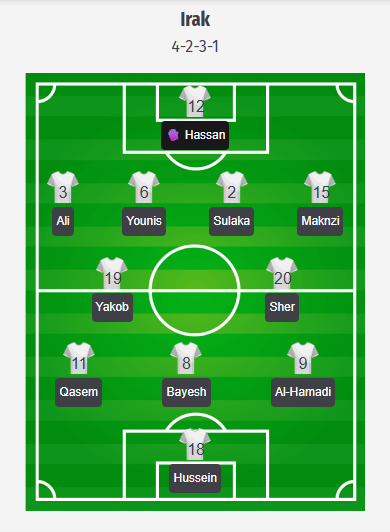
Iraq could line up in a 4-2-3-1, with Jalal Hassan (12) expected to start in goal. Manaf Younis (6) and Rebin Sulaka (2) are likely to form the central defensive pairing, with Kevin Yakob (19) and Aimar Sher (20) anchoring the midfield in front of them. With no injuries reported, Ibrahim Bayesh (8) and Aymen Hussein (18) are expected to be the key focal points in the attack.
Norway Form & Record Check
Norway’s camp appeared relaxed on the surface—from Haaland’s rounds of golf to the squad’s video game breaks—but from a sporting perspective, the situation is quite clear. Ståle Solbakken’s team won all eight European qualifying matches and scored 37 goals; they then reinforced that status with a 3–1 victory over Sweden and a hard-fought 1–1 draw against Morocco in their most recent friendlies. The 1–1 draw in Morocco was revealing because it demonstrated once again that Norway is not just a counterattacking team. Martin Ødegaard can slow the pace, Oscar Bobb and Antonio Nusa stretch the field, and Erling Haaland adds value to nearly every cross and through ball. Nevertheless, Norway has conceded goals in four of its last five competitive matches across all competitions, so control isn’t automatically guaranteed. The broader picture of their form has more substance than the usual pre-tournament confidence. A 0–0 draw against Switzerland showed patience, the 2–1 loss to the Netherlands revealed that defensive work still needs to be done, and the 1–4 away win in Italy remains the result that classifies Norway as a dangerous opponent. With Alexander Sørloth and Jørgen Strand Larsen as additional options, this team certainly doesn’t lack power in the penalty area.
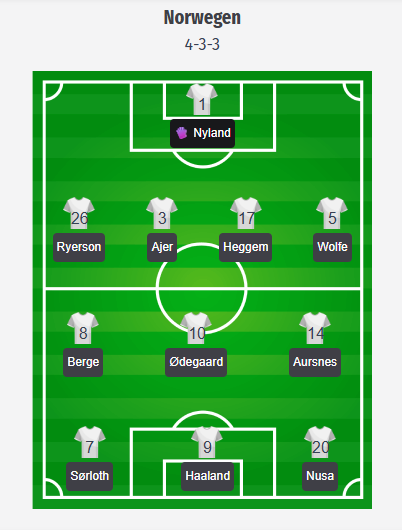
Ståle Solbakken’s likely starting lineup is expected to feature a 4-3-3 formation, with Ørjan Nyland in goal and a central defensive pairing of Kristoffer Ajer (3) and Torbjørn Heggem (17). With no injuries reported, Sander Berge (8), Martin Ødegaard (10), and Fredrik Aursnes (14) are set to feature in midfield, supporting Erling Haaland (9), Alexander Sørloth (7), and Antonio Nusa (20).
Iraq vs. Norway Head-to-Head & Statistics
The available data shows no previous matchups between these two teams, so there is no current trend in head-to-head play to draw upon. That is precisely why the early stages of the game will be crucial. Iraq has no recent tactical reference point for containing Norway’s current offensive structure, while Norway must assess Iraq’s form, physical profile, and ability to keep games close.