Key Facts
- Bremen (14th) is under massive relegation pressure, sitting just one point ahead of Mönchengladbach; Leipzig (4th) is trying to make up three points to reach a Champions League spot – both teams are under different but significant pressure.
- Bremen’s defense is severely weakened by five absences (Pieper, Stark, Wöber, Malatini, Weiser); Werder will have to rely more on quick transitions rather than structured stability in their build-up play.
- Romano Schmid and Justin Njinmah are carrying the brunt of Bremen’s offense; Njinmah recently scored the decisive goal in Wolfsburg because Victor Boniface is not yet ready to play despite returning to training.
- Leipzig has conceded at least one goal in five consecutive away games – despite Leipzig’s strong home form, Bremen’s chances remain realistic, even without standout attacker Gruda.
- H2H trend: Leipzig scored in three of the last five head-to-head matches after halftime; Bremen conceded in each of those exact three games after halftime—a tactically significant pattern.
- Four of the last five matchups had fewer than 3.5 goals; however, due to Bremen’s personnel issues in defense and Leipzig’s combined expected goals value of around 3.2, a higher-scoring game is likely this time.
Ole Werner returns to the Weserstadion with RB Leipzig on Saturday, facing the club he left last summer. The visitors arrive riding the momentum of a 5-0 victory over Hoffenheim, while Bremen recently managed a hard-fought 1-0 win in Wolfsburg. Leipzig had already come out on top 2-0 in the first leg back in November. A glance at the standings underscores the stakes: Bremen sits in 14th place, just one point behind Borussia Mönchengladbach and two points ahead of 1. FC Köln, while Leipzig is in fourth place, three points behind Stuttgart and tied on points with Hoffenheim in the race for Champions League spots.
- Venue: Weserstadion, Bremen
- Date and time: April 4, 2026, 3:30 PM
- Competition: Bundesliga (Matchday 28)
The betting market clearly favors Leipzig, and there are good reasons to expect an away win, as Bremen is missing Karl Hein and several defenders, and SVW’s home form is anything but reliable. Nevertheless, a nuanced view is warranted. Leipzig has conceded in five consecutive away league games, Brajan Gruda is out, and Bremen has won three of its last five matches.
Werder Form & Record Check
Bremen enters this match riding the momentum of a 1-0 away win in Wolfsburg, decided by Justin Njinmah, and this result carried significant weight following the weak home loss to Mainz.
The fact that Daniel Thioune’s team has won three of their last five Bundesliga matches gives them a real chance, but their performances have been more inconsistent than stable, lacking true composure in possession or a discernible rhythm between the penalty areas.
The bigger problem lies in the team’s structure. Bremen has only one home win in their last eight league games, and the defense is noticeably suffering from the absences of Amos Pieper, Niklas Stark, Maximilian Wöber, Julian Malatini, and Mitchell Weiser. Victor Boniface is back in training, but not yet ready to make a difference, which is why much of the offensive burden continues to fall on Romano Schmid and Justin Njinmah.
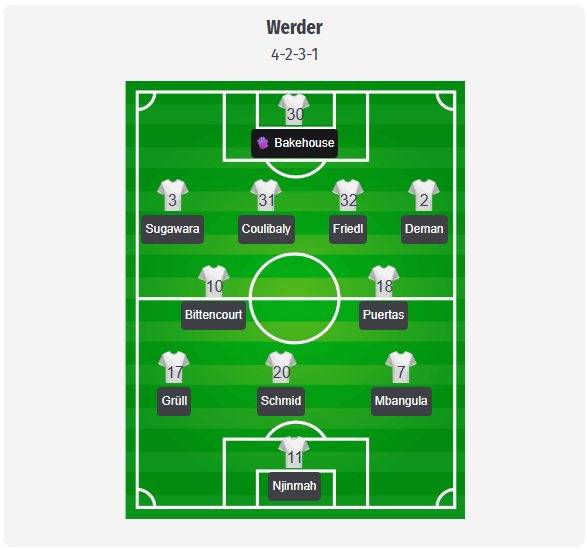
This is, of course, still just a prediction, but there are many indications that Bremen will stick with the 4-2-3-1 formation. With Karl Hein out, Mio Backhaus is expected to start in goal, and Mitchell Weiser’s injury should ensure that Yukinari Sugawara continues to play at right back. Karim Coulibaly and Marco Friedl would then form the central defensive pairing, with Olivier Deman completing the back four.
Further up the field, the prediction sees Leonardo Bittencourt and Cameron Puertas in defensive midfield, with Marco Grüll, Romano Schmid, and Samuel Mbangula behind them supporting Justin Njinmah. With Niklas Stark, Amos Pieper, Maximilian Wöber, Julian Malatini, Victor Boniface, and Keke Topp all out, Werder will likely rely more on movement and quick transitions than on physical presence.
Leipzig Form & Record Check
Leipzig made a convincing return with a 5-0 win over Hoffenheim, and the manner in which this victory was achieved was at least as important as the result itself. Christoph Baumgartner found the gaps early on, David Raum consistently delivered quality from the left, and the pressing looked sharply coordinated once again. In their last five Bundesliga matches, Leipzig earned ten points, losing only in Stuttgart.
The away record is hard to ignore. In five consecutive away league matches, Leipzig conceded at least one goal in each game, so strong results did not always go hand in hand with a solid defense. The absence of Brajan Gruda is noticeable; he was the most prominent attacker against Hoffenheim. On the other hand, Yan Diomande is fit again, and Peter Gulacsi and Assan Ouédraogo are back in Ole Werner’s squad. The bench is getting deeper, and that comes at just the right time.
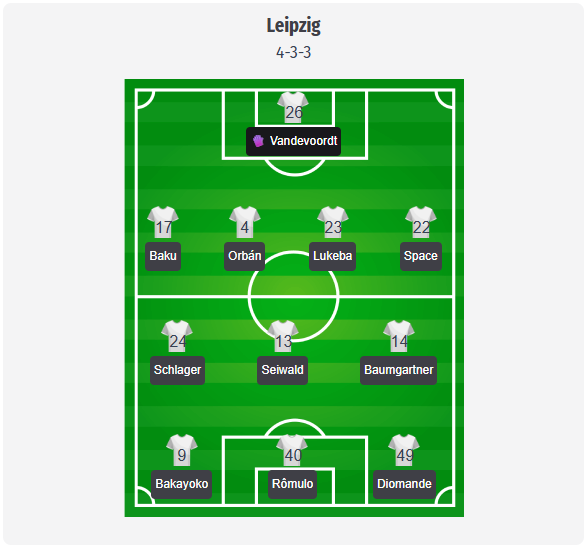
RB Leipzig is likely to line up in a 4-3-3, though this is a prediction and not a confirmed lineup. Maarten Vandevoordt could start in goal, in front of a back four consisting of Ridle Baku, Willi Orbán, Castello Lukeba, and David Raum. Xaver Schlager and Nicolas Seiwald are expected to provide structure and cover in midfield.
Further up the field, Christoph Baumgartner would likely act as the link between Johan Bakayoko, Rômulo, and Yan Diomande. On the sidelines are Brajan Gruda, Leopold Zingerle, Viggo Gebel, and Suleman Sani, while Benjamin Henrichs may start on the bench following his long layoff. Antonio Nusa would be another option should Werner want more depth on the wings.
Werder – Leipzig Head-to-Head & Stats
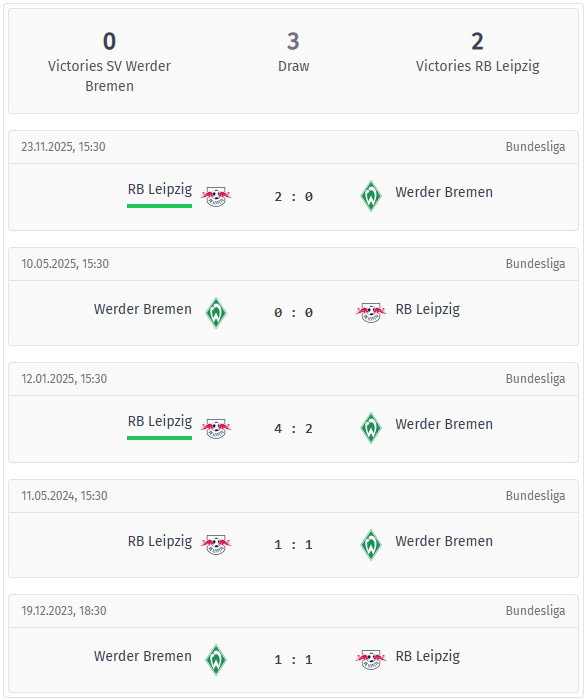
Recent encounters have gone in Leipzig’s favor, though the series hasn’t become one-sided. In their last five matches against Bremen, the Saxons are unbeaten, winning 2-0 in November 2025 and 4-2 in 2025, with draws in May 2025, 2024, and 2023. This record carries weight, as Bremen has simply failed to turn close games in this rivalry into wins.
The pattern within these results is quite specific. Four of the five matches saw fewer than 3.5 goals, but four also exceeded the 1.5-goal mark, which shows that these games are usually controlled, not chaotic. The most striking trend emerges after halftime. Leipzig scored in the second half in three consecutive matches, and Bremen conceded in each of those exact three games after the break.