When the 18th-placed team in Serie A hosts the 17th-placed team with only one point separating them, a normal Monday evening at the Arena Garibaldi suddenly becomes a six-point game. Pisa is under pressure, as is Parma, because the loser could slip even deeper into the relegation zone. Pisa put up a fight against Inter recently, but lost 0-2, with both goals coming after the 69th minute. This underlines that the defense can keep up for a long time, but the attack remains a real problem child. Added to this are significant absences, including Stengs, Cuadrado, Esteves, Akinsanmiro, and Vural, which noticeably thin out the depth in midfield and up front and force Alberto Gilardino to adopt a more compact, defensive system.
Parma travels to Pisa after being knocked out of the Coppa Italia by Bologna and has been waiting for a win in the league for four games. The team is only slightly better off than Pisa, with inconsistency being the recurring theme. Interestingly, the bookmakers see both teams as almost equal, reflecting their similar difficulties in form and results.
This is the first time they have met in Serie A, having previously played five times in Serie B. Parma won the last meeting 3-2 at the Tardini in February 2024. Overall, these games have mostly been close, with four of the five encounters having balanced first halves and 80% of them seeing fewer than 3.5 goals scored. This suggests a cautious start to the game and a low to medium number of goals overall.
Given the importance of the game, the depleted midfields, and the recent defensive fragility shown by both sides, a more cautious, slower start is to be expected, with the focus clearly on avoiding mistakes. The team that maintains its shape better and makes more efficient use of set pieces or counterattacks in the closing stages is likely to have the advantage. Likely scenarios are a low-scoring draw or a narrow home win for Pisa or an away win for Parma. As both teams struggle to convert chances consistently and are likely to play conservatively, under 2.5 or under 3.5 goals and a draw seem like obvious options, but late goals are still possible if the pressure increases in the final minutes. The decisive factors will be whether Pisa can develop enough attacking power without its key creative players and wingers, how Parma reacts to its Coppa exit, and which midfielders control the tempo. Added to this is the question of who will defend more concentratedly from set pieces and remain more stable in the final stages, as previous encounters have often been decided after the hour mark.
- Venue: Arena Garibaldi – Stadio Romeo Anconetani, Pisa
- Date and time: December 8, 2025, 3:00 p.m.
- Competition: Serie A (matchday 14)
The market odds, with a home odds of 2.5, suggest a largely balanced contest, but several situational factors shift the value slightly toward Parma. Pisa’s injury crisis, with seven players out, including midfielders Vural and Akinsanmiro, as well as their tendency to play very cautiously in the first half, with five consecutive starts ending either 0-0 or 1-1 at halftime, increase the likelihood of a low-scoring, cautious game. In just such a game, Parma could make better use of its greater squad depth, especially in the second half.
As a bet, the double chance of a draw or away team, i.e., X2, is a sensible, slightly less risky tip. With Parma’s odds at 3.2, it is particularly plausible to bet on Parma not losing, X2.
The risks include Parma’s recent mediocre form and the possibility that Pisa’s absences will weaken their attack more than their midfield control, which could lead to a surprising game. It therefore makes sense to place a rather conservative bet of around 1 to 3% of your bankroll or to supplement X2 with an under total of goals in a small-volume combination bet, provided the odds are right. It is also important to keep an eye on the final lineups and the course of the game, as late personnel changes or even the weather can significantly shift the value.
Pisa form & record check
Pisa is in 18th place in Serie A with 10 points from 13 games. In their last five games, they have recorded one win and four draws, leaving them just one point above the relegation zone. The picture is clear: the team is showing resilience, but too rarely manages to convert decent performances into actual wins.
A key pattern is their restraint before the break, with Pisa drawing every first half in their last five games. This suggests a very cautious, defensively oriented start that prevents early goals but regularly forces the team to chase the game in the second half. Added to this is a noticeable drop in performance after the break, with intensity waning and late goals conceded, such as Lautaro Martínez’s late double against Inter. Pisa produces little offensively anyway, lacking punch in the final third, so the team has to rely heavily on defensive organization. The absences of Stengs, Akinsanmiro, Vural, Esteves, and Cuadrado further reduce the squad’s creativity, width, and experience, limiting both tactical adjustments during the game and the impact of the bench.
In the short term, adjustments in match management are particularly needed. After a cautious start, a slightly bolder approach between the 20th and 30th minutes, for example with slightly higher pressing or faster transitions, would be helpful to avoid constantly having to chase the game. In order to create chances despite a lack of creativity on the wings, overlapping fullbacks or inverted wingers who occupy the half-spaces, supported by advancing midfielders who outnumber the striker, are a good option. At the same time, concentration in the final phase and defensive organization must be improved. Fresh legs around the 65th to 70th minute and targeted training in defending set pieces and counterattacks are obvious levers. This also includes a game-related pragmatism of accepting less possession against top opponents and relying on clearly structured counterattacks, while taking the initiative earlier against teams of equal or weaker strength.
At the personnel level, recovery and sensible rotation planning should be a priority so that returning creative players can be reintegrated without losing the balance in the team. Training should focus on sharpening decision-making and efficiency in the final third, for example through small-group games with quick combinations and finishes from the penalty area. A clear substitution plan for the last 25 minutes or so, for example with a strong winger and an attacking midfielder, can provide additional momentum. Despite the injuries and low goal tally, Pisa is far from lost. If Gilardino manages to make the first half a little more proactive, provide fresh legs in the final stages, and establish a reliable source of shots on goal, whether through a striker, a late-arriving midfielder, or set pieces, some of the many draws can be turned into wins and the relegation battle can gradually be left behind. The immediate focus must be on regaining creative options and turning small chances into real goals.
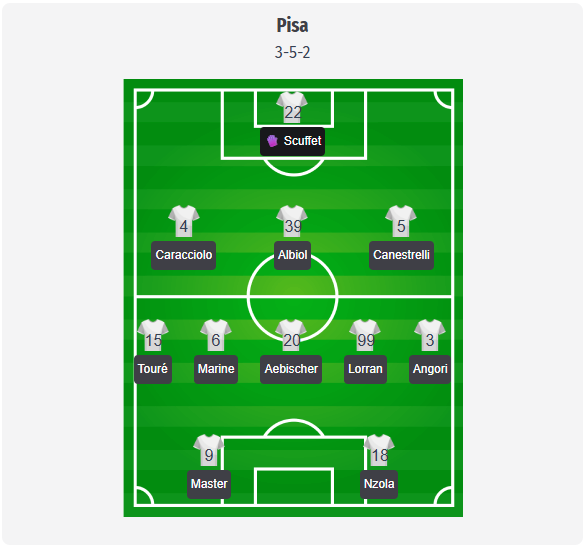
Pisa are expected to line up in a 3-5-2 formation for this match. Scuffet will be in goal, with a back three of Caracciolo, Albiol and Canestrelli in front of him. Touré will play on the left wing and Angori on the right, with Marin, Aebischer and Lorran expected to play in central midfield. Meister and Nzola are expected to provide presence and finishing in the center of the attack.
Stengs is unavailable after groin surgery, as are midfielders Akinsanmiro and Vural, while Cuadrado and Esteves, important options at full-back and on the wing, are also missing. These absences deprive Pisa of their most creative offensive source in Stengs, reduce the depth in midfield, and limit the options on the wings, which restricts Alberto Gilardino’s ability to switch to a more offensive formation or rotate on the wings in a crucial relegation battle where three points are desperately needed.
Parma Form & Record Check
Parma are 17th in Serie A with 11 points from 13 games and have won only once in their last five league games, a 2-1 away win in Verona. Recent results include home defeats to Udinese (0-2) and Bologna (1-3), as well as a 1-2 Coppa Italia exit against Bologna during the week.
The biggest area for improvement is defensive stability. Parma has conceded at least one goal in each of its last five games and has never kept a clean sheet in this run. There is certainly danger in attack, with the team scoring in four of those five games, but time and again, late or decisive goals have undone their work, exemplified by Castro’s 89th-minute winner in the Coppa Italia against Bologna, which also devalued positive performances such as the 2-2 draw against Milan.
In terms of discipline, it should be noted that Troilo received a red card in the Coppa Italia defeat, but remains eligible to play in the league as the suspension only applies to that competition. In addition, there is transfer interest in striker Pellegrino off the pitch, including from Milan, which could cause unrest in the environment if not properly moderated. In the short term, there are therefore several points at the top of the agenda: the defensive organization must be tighter, starting with the basic formation for set pieces, through to behavior in transition moments, to clearer individual responsibilities. Equally important is greater concentration and better game management in the final stages to avoid late goals. Tactical adjustments such as a more compact midfield, a double six, or deliberately defensive substitution patterns can help reduce vulnerability. At the same time, Carlos Cuesta must keep the team focused despite possible speculation about Pellegrino and, if resources allow in January, consider short-term reinforcements in defense. The situation is delicate, with Parma level on points with Genoa and only one point ahead of Pisa, so quick and targeted improvements are needed to move away from the relegation zone.
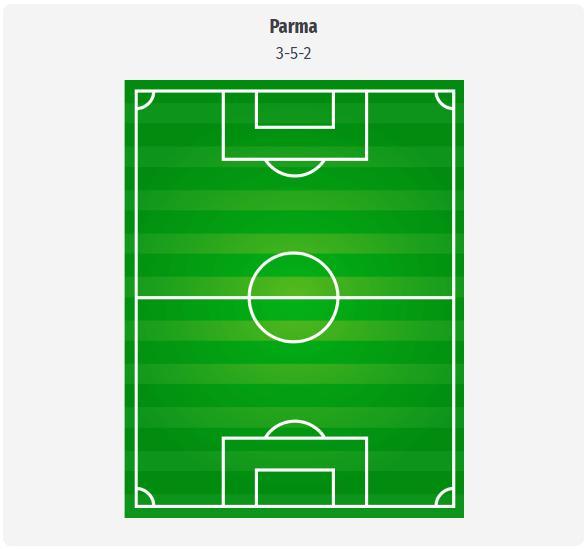
Parma are likely to line up in their usual 3-5-2 formation under Carlos Cuesta. The only forced change is the absence of Emir Troilo, who is suspended for one game after receiving a red card, which means a replacement is needed in the back three, likely one of the backup center backs. Apart from Troilo’s suspension, there are no new injury concerns, so Cuesta can basically rely on a largely predictable starting lineup.
Tactically, the coach has two main options: either a direct replacement moves into the back three as a center back, or one of the wingbacks is pulled inside and replaced on the flank. However, given the otherwise stable squad situation, there is a lot to be said for choosing the simple solution and putting a trained center back in the back three.
Pisa – Parma Head-to-head comparison & statistics
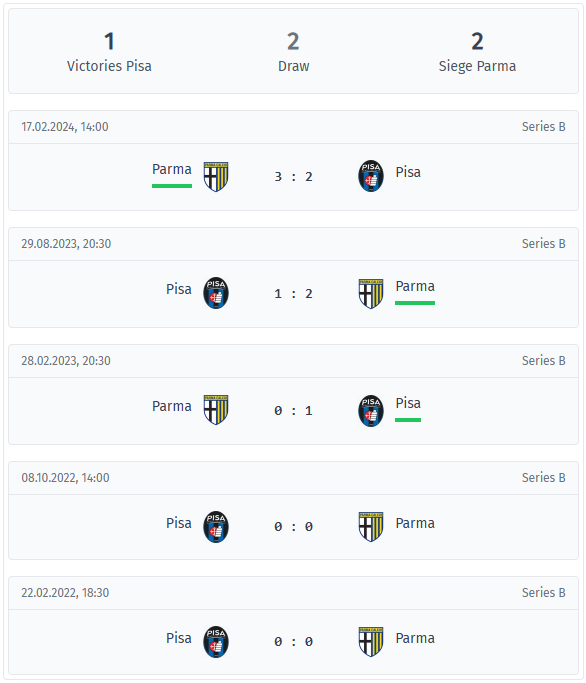
In the five most recent direct duels, all played in Serie B before both teams were promoted, Parma has the slightly better record with two wins, Pisa has one win, and two games ended in a draw.
Parma won the two most recent encounters, 3-2 at home in February 2024 and 2-1 away at the Arena Garibaldi in August 2023. Pisa’s only win in this series was a 1-0 away victory in Parma in 2023. The two previous matches in 2022 ended 0-0 and were both played at Pisa’s stadium.
Overall, these duels have mostly been close and cautious. In four of the five games, there were under 1.5 goals in the first half, and in 80% of the cases, the score was tied at halftime. Goal production also remained rather low over the entire duration of the games, with four of the five encounters seeing under 3.5 goals and, between 2022 and early 2023, there was a series of three consecutive games that each ended with under 2.5 goals.
Only the two most recent encounters in August 2023 and February 2024 broke this pattern, with a combined total of seven goals, briefly suggesting more open, high-scoring games. Nevertheless, the long-term trend suggests that both teams are usually well organized defensively in direct duels and tend to approach these encounters cautiously.