Eleven home games in a row with at least two goals scored, seven Premier League games without defeat on the other, against this backdrop, Newcastle welcomes a resurgent Leeds to St James’ Park on Wednesday, January 7. Eddie Howe’s team is in ninth place with 29 points, sandwiched between Sunderland and Brighton in the tight midfield, while Daniel Farke’s team arrives in 16th place with 22 points, placed between Bournemouth and Nottingham Forest, four points ahead of Forest and eight points above the relegation zone. Recent form points to a clear contrast in playing styles, with Newcastle winning three of their last five games and dispatching Crystal Palace 2-0, extending a run of eleven home games with at least two goals, fueled by set pieces from Bruno Guimarães and Thiaw. Leeds, unbeaten in seven league games and with strong draws at Liverpool and against Manchester United, look much more robust in Farque’s five-man defense, while Aaronson is increasingly shaping the attacking play. The history between the two clubs promises a closer contest than the bookmakers suggest. Newcastle have not lost in their last five league games against Leeds, but the last three encounters have all ended in draws, including a 0-0 stalemate at Elland Road in August. The hosts are clear favorites going into this game, but Leeds will be looking to translate their new-found defensive stability into another important away result, so patience rather than risk-taking could be the guiding principle for the evening.
- Venue: St. James’ Park, Newcastle
- Date and time: January 7, 2026, 9:15 p.m.
- Competition: Premier League (Matchday 21)
Newcastle’s strong home form, supported by set pieces, and Bruno’s goal streak clearly point to a Newcastle win, while Leeds’ unbeaten run, Aaronson’s revival, and the hard-fought point at Anfield suggest that both teams will score: Yes, and that Newcastle could take the lead before halftime.
Newcastle form & record check
Newcastle go into this game against Leeds in their best form for some time, with three wins and a draw from their last five games in all competitions, including Premier League victories of 3-1 at Burnley and 2-0 against Crystal Palace at St James’ Park, which have pushed the team to ninth in the table with 29 points, just one point behind Sunderland and one ahead of Brighton in an extremely tight field. Offensively, the numbers are clear: Newcastle have scored in 80% of their last five games, 80% of those games ended with more than one and a half goals, and they have scored at least two goals in eleven consecutive home games, with Bruno Guimarães scoring against Palace and leading a series of set pieces that have yielded a total of ten league goals by targeting Malick Thiaw, Fabian Schär, and Nick Woltemade. Defensively, the picture is less reassuring, with Newcastle conceding goals in 80% of these encounters. The game against Palace, in which they did not concede, remains the exception, and the 1-0 defeat at Manchester United once again highlighted their continued vulnerability away from home. With Dan Burn injured, Eddie Howe is relying heavily on Malick Thiaw, Sven Botman, and Fabian Schär in central defense, while Nick Pope remains the clear number one in goal. Overall, this constellation fits with recent predictions that place Newcastle in the race for Champions League places rather than at the very top of the table. Optas’ model saw them just behind Manchester United, and the current league table underscores this picture, even if their strength from set pieces and their home scoring streak leave room for improvement.
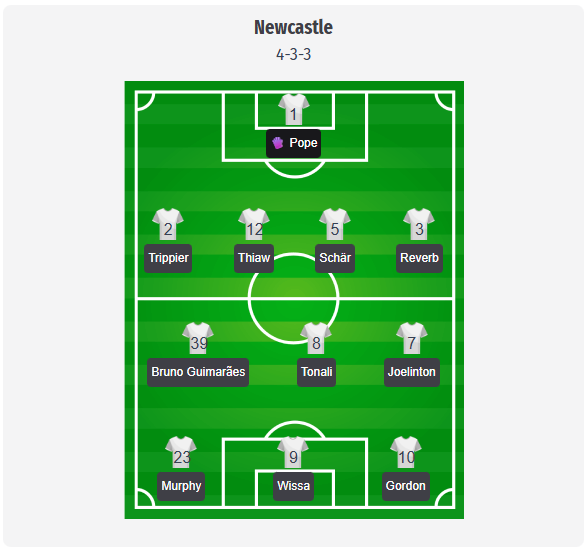
At Newcastle, Eddie Howe is expected to stick with his familiar 4-3-3 formation, with Pope in goal behind a back four of Trippier, Thiaw, Schär, and Hall, with Bruno Guimarães, Tonali, and Joelinton once again stabilizing the midfield in front of them, forming the basis for Murphy and Gordon, who will each play alongside Wissa. This structure has supported Newcastle’s recent development, but it remains a probable lineup and nothing has been confirmed yet. With Burn out with a bruised rib and Osula also missing with an ankle injury, Hall is likely to retain his place and Wissa is expected to lead the line. Set pieces could once again play a big role, as Thiaw and Bruno Guimarães pose a considerable threat in this area, while Botman, Livramento, Barnes, and Elanga Howe give Howe additional flexibility if he needs more control or more direct pace.
Leeds Form & Record Check
Leeds travels to this Premier League match on the back of a rather quiet, but impressive run into this Premier League game, having gone seven league games unbeaten, with four draws and a resounding 4-1 win over Crystal Palace in their last five, which has taken them to 16th in the table with 22 points and a goal difference of minus seven, giving them a noticeable cushion above the relegation zone. The 1-1 draw against Manchester United at Elland Road felt like a missed opportunity, as Leeds took the lead through Aaronson and conceded the equalizer almost immediately. At Anfield, the team presented a tight defensive formation and fought to a 0-0 draw against Liverpool. Previously, away draws of 1-1 at Brentford and 1-1 at Sunderland had underlined the team’s growing resilience, even if the lack of clinical finishing in attack continues to be noticeable. Farke’s switch to a 5-3-2 formation has noticeably stabilized Leeds. The games are mostly cautious before halftime and then become more open, which suits a team that has scored in four of its last five games and conceded goals in four of those games. Aaronson has gained significantly in importance, and the influence of substitutes such as Okafor and Gruev points to greater squad depth. Interestingly, the system itself seems to be becoming an increasingly key component. However, the picture is not entirely flawless. Leeds has won only two of these seven unbeaten games, both at Elland Road, and six of the eight league defeats were suffered away from home. While Bogle, Rodon, and James are missing, substitutes Justin, Bornauw, and Gruev have impressed, but Perris’ recent mistake keeps the goalkeeping position in the spotlight. Nevertheless, eight points above the relegation zone and one point behind Bournemouth, the overall trend seems to be slightly upward.
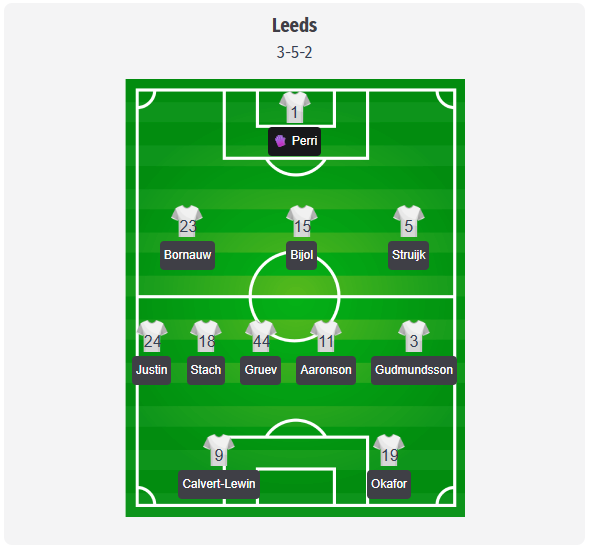
At Leeds, there are many indications that Daniel Farke will stick with the 3-5-2 formation that has been the basis for the team’s seven-game unbeaten streak in the league. Our predicted lineup sees Perri in goal behind a back three of Bornauw, Bijol, and Struijk, with Justin and Gudmundsson once again providing width on the flanks, Stach and Gruev securing the center, and Aaronson operating between the lines to link up the front pairing of Calvert-Lewin and Okafor. Rodon, Bogle, and James are expected to remain sidelined, so our predicted lineup stays close to the group that has carried this streak, with Bornauw and Justin retaining their places and Aaronson pressing centrally. Ampadu, Longstaff, Tanaka, Harrison, Gnonto, and Piroe could come off the bench if Farke is looking for fresh legs or a late switch to a front three.
Newcastle – Leeds Head-to-Head Comparison & Statistics
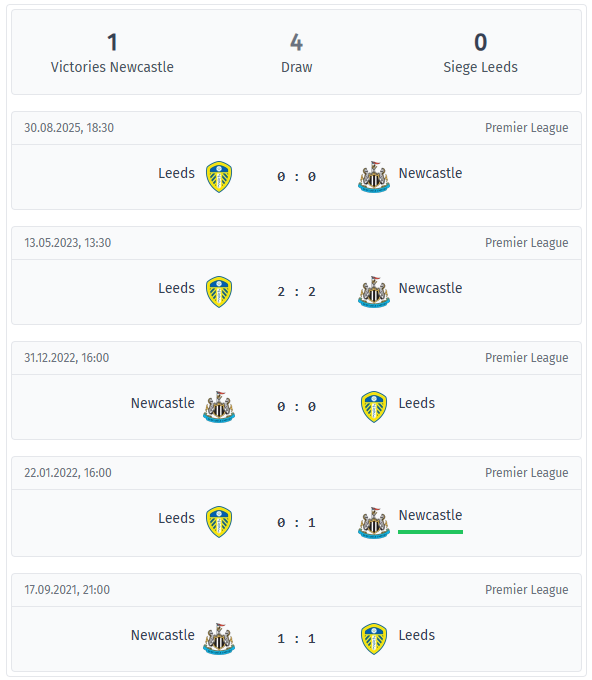
In a direct comparison of the two clubs, Newcastle have remained unbeaten in their last five league encounters from 2021 to August 2025, with one win and four draws. Leeds have yet to pick up three points in this series, with Newcastle notably more productive away from home, winning once and drawing twice at Elland Road, while both encounters at St James’ Park ended in draws. Four of these five games ended in draws, including the three most recent encounters with scores of 0-0, 2-2, and 0-0. The only clear result was Newcastle’s 1-0 win in 2022. Every encounter was close, with no game in this series decided by more than one goal, meaning the gap between the teams remained minimal throughout. The first halves also followed a remarkably consistent pattern, with all five halftime scores ending in a draw and only one team managing to score before the break. After the break, goals were also rare, with four of the five games seeing no more than one goal in the second half, underscoring how cautious these matches often become as they progress. The combination of five consecutive draws in the first half and generally low-scoring games points to a matchup that is characterized more by control than chaos. The head-to-head form suggests caution on both sides. Leeds seem content to keep the game balanced, while Newcastle have so far been unable to convert their advantage into regular wins, so it seems that patience will once again be the decisive factor.