In sporting terms, two teams from the lower half of the table are facing each other, separated by just four points. Hamburg has 12 points from 12 league games, with mixed results recently: A dramatic late league goal against Stuttgart was followed by elimination from the DFB Cup against Holstein Kiel after extra time and a penalty shootout, preceded by three consecutive defeats in the league. Significant injury problems are an additional burden, with key strikers Robert Glatzel and Yussuf Poulsen missing, as is Alexander Røssing Lelesiit, which significantly limits the options and depth in attack. Werder, on the other hand, are on a small run, unbeaten in their last three league games, and fought hard to earn a robust draw in Cologne last weekend despite Niklas Stark’s sending-off and a late equalizer. Defensively, Maximilian Wöber, Julián Malatini, and Mitchell Weiser are missing, and Stark is suspended, but at least Stage and Mbangula are fit again, giving coach Horst Steffen new options. The rivalry elevates this match well above the current league table, with the last Bundesliga encounters in 2017/18 resulting in a 0-0 draw in Hamburg and a narrow home win for Bremen at the Weserstadion. In later second division clashes, both clubs prevailed away from home, and often the heated atmosphere and local pride have influenced the result just as much as the form curve.
Tactically, HSV must find ways to create enough chances and finish consistently without their injured strikers, while Werder will need to reorganize their defense without several regulars, but at the same time build on their recent stability and the return of important players. Given the defensive problems of both teams, set pieces and concentration in the final minutes could be the deciding factor. Nevertheless, the bookmakers see a slight advantage for Hamburger SV, reflecting home advantage and the derby setting despite the hosts’ inconsistent form.
- Venue: Volksparkstadion, Hamburg
- Date and time: December 7, 2025, 3:30 p.m.
- Competition: Bundesliga (Matchday 13)
The betting markets see Hamburger SV as slight favorites at odds of around 2.3, and given the home advantage in the first Bundesliga North derby since 2018, there is certainly value in betting on Hamburger SV to win. Familiarity with the Volksparkstadion and the emotional charge of the derby may partially offset the DFB Cup slip-up against Holstein Kiel during the week.
Werder Bremen will be missing key defenders, which increases the likelihood of both teams scoring: Yes, even though the season as a whole has started with few goals. Recent form shows defensive weaknesses on both sides, which suggests at least one goal each. In recent head-to-head matches, the first halves have often been relatively quiet, which supports a bet on under 1.5 goals at halftime. Given the current defensive problems overall, a combined strategy is advisable: conservative under 1.5 goals at halftime and at the same time both teams to score: yes over the entire 90 minutes.
HSV Form & Record Check
Hamburger SV is currently in 13th place in the table with 12 points and a goal difference of minus 7. In the last five league games, the record is one win, two draws, and two losses, i.e., W D L L D. The gaps to their direct competitors are small, they are two points ahead of Augsburg and three behind Union Berlin, and the current momentum seems rather weak overall. Defensively, the team has conceded goals in four consecutive competitive games, with a clear tendency for late goals from the opposition; in four of the last five games, the goals were conceded after the break. This may indicate a decline in fitness, ineffective adjustments at halftime, or lapses in concentration as games become more open.
Hamburg are also struggling to get going offensively. They have not won the second half in any of their last five games, and in none of those games did they score more than one goal before the break. These slow starts regularly force them to chase deficits, and the 4-1 defeat in Cologne is a recent example of how dangerous it can be when early control is lost. At the same time, there are positive signs. The 2-1 win against Stuttgart, with a goal in stoppage time and with a man down, impressively demonstrated that the team has character and is capable of forcing late results even under pressure. That is a psychological anchor that can be built on. However, the DFB Cup exit against Holstein Kiel after extra time and a penalty shootout remains painful, including a late free kick that forced extra time and the lost shootout, which both undermines confidence and reveals weaknesses in set pieces and in preparation for penalty shootouts.
The personnel situation exacerbates many things. Key strikers Robert Glatzel, Yussuf Poulsen, and Alexander Røssing Lelesiit are out with muscle fiber tears, and defenders Daniel Elfadli and Warmed Omari are also unavailable, even though there had been hopes for a quicker return for Elfadli and Poulsen. These absences severely limit the offensive options as well as defensive stability. The situation is also causing unrest in goal, with loan goalkeeper Daniel Peretz publicly expressing his displeasure at losing his place to Heuer Fernandes. Such statements can become a burden in the dressing room if they are not handled sensitively, but coach Merlin Polzin is currently standing firmly behind Heuer.
In the short term, with a view to the next two to three games, the focus in training should be on fitness and concentration in the final stages. This includes specific conditioning sessions that simulate the intensity of the last 20 minutes, as well as regular game situations in which leads must be defended or longer periods of being a man down must be endured. Equally important is reviewing the procedures during the half-time break and the reactions to opposing substitutions, including the option of becoming more pragmatic in the final minutes, for example with a more compact formation such as a deep 4-4-1 or 4-5-1, or the targeted substitution of a defensive midfielder to protect the central defense. At the same time, set pieces, both offensive and defensive, should be given high priority, with clear responsibilities for man-to-man and zone coverage, and counter-pressing after losing the ball must be sharpened to reduce dangerous transitions by the opponent. The goalkeeper issue needs to be clarified internally, ideally in a confidential conversation with Peretz, in which his views are heard, the sporting decision is explained, and a transparent plan for playing time, for example in cup games or clearly defined rotation windows, is presented without bringing this discussion into the public eye. In view of the many absences in attack, pragmatic squad rotation is also required, with a focus on compactness and quick transitions rather than excessive offensive commitment.
In the medium term, i.e., beyond the recovery phases and the upcoming transfer window, the focus should be on proper medical management. The return-to-play protocols for muscle fiber tears should be accelerated as far as reasonable, but at the same time implemented with a strong focus on safety, including close monitoring of exertion and individual strength and conditioning plans to prevent relapses. For squad planning in January, it is worth looking at a mobile center back or an energetic box-to-box midfielder who can provide more control, especially in the late stages of games, and, if the offensive absences drag on, also at short-term reinforcements in attack. In internal and external communications, the resilience shown against Stuttgart should be specifically highlighted in order to stabilize confidence. Video analysis can help to reinforce correct behavior in the final minutes and highlight individual positive contributions, while messages regarding the goalkeeper issue must remain consistent so that the squad does not become divided.
A number of key indicators are suitable for monitoring and should be observed on a weekly basis, such as the number of goals conceded after the 60th minute, the points haul from games in which the team was in the lead, the ratio of expected goals in the first and second halves, the number of goals conceded from set pieces, the goalkeeper’s save percentage, and penalty performance in training. Overall, the current problems at Hamburger SV can be clearly identified and addressed. Essentially, they relate to fitness and tactical discipline in the second half, the large number of injuries, and a potential distraction caused by the goalkeeper issue. The immediate priorities should therefore be to stabilize the final phases of games, manage the Peretz situation internally in a clean manner, and use the next few games to consolidate results and clarify the need for possible short-term reinforcements.
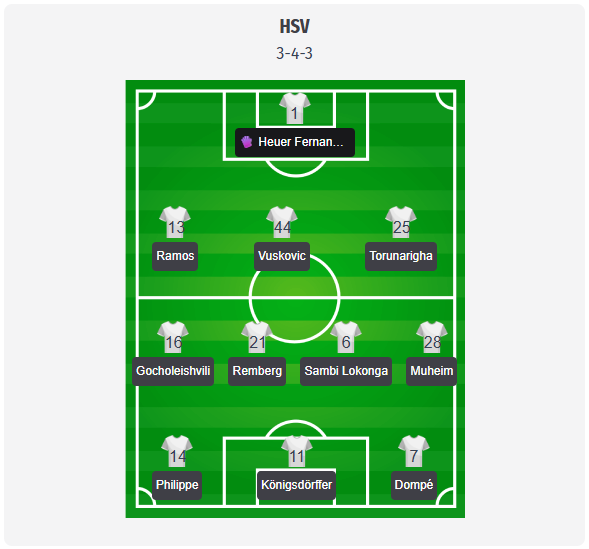
Merlin Polzin is expected to field his familiar 3-4-3 system. Robert Glatzel and Yussuf Poulsen remain key absentees, both unavailable in attack, as does Warmed Omari in defense. Daniel Elfadli and Poulsen were considered hopefuls for a return, but remain unavailable for the derby.
With Glatzel out, Philippe is expected to lead the attack, with Königsdörffer and Dompé on the wings. Heuer Fernandes is likely to remain in goal, although Peretz is pushing for more playing time and applying pressure internally.
The back three is likely to consist of Ramos, Vuskovic, and Torunarigha, with Sambi Lokonga and Remberg providing stability and balance in central midfield.
Werder Form & Record Check
Werder Bremen are currently 10th in the table with 16 points, level on points with Borussia Mönchengladbach and one point ahead of 1. FC Köln. In their last five league games, the team has recorded two wins, two draws and one defeat, a run that suggests growing consistency but not yet true dominance. It is striking that Bremen has not scored more than one goal in the first half in any of these five games. They often start cautiously and tend to find their way into the game gradually, scoring in four of these five encounters, but often late rather than taking control early on.
The latest results underscore this pattern. In the 1-1 home draw against Cologne, Marco Friedl gave Werder an early lead, but despite some good spells, they were unable to add to their tally and conceded the equalizer in stoppage time. Prior to that, they suffered a heavy 2-0 defeat at RB Leipzig, while a 2-1 home win against Wolfsburg showed their quality in their own stadium and at the same time highlighted their inconsistency against stronger opponents. The personnel situation in defense is a major cause for concern. Felix Agu, Julián Malatini, and Maximilian Wöber are injured, Niklas Stark is suspended after receiving his second yellow card in stoppage time against Cologne, and the early substitution of Amos Pieper in that same game after he replaced Stark further increases the uncertainty, even though Stage and Mbangula are available again and offer new options.
Tactically, there is much to suggest that Bremen will initially play cautiously in the derby and try to work their way into the game with a stable formation, before building up more pressure in the second half, especially from set pieces, where Friedl, for example, repeatedly poses a threat, rather than playing at a high tempo and pressing continuously from the start. The necessary changes in defense could create gaps and make the team vulnerable to quick transitions and high-quality strikers. Overall, Werder has sufficient offensive quality and has repeatedly shown resilience recently, but the combination of slow starts, personnel losses in defense, and occasional lapses in concentration, especially against top teams, makes them vulnerable. To climb further up the table, they need more control in the first half and a more consistent defensive performance over 90 minutes.
In terms of predictions, it can be said that games in which Bremen are short-staffed in central defense are likely to be characterized by a cautious first half and a more open second half. Close games are likely, and when making predictions or betting tips, it should be taken into account that late goals and an increased probability of conceding goals are currently a fixed part of the risk calculation.
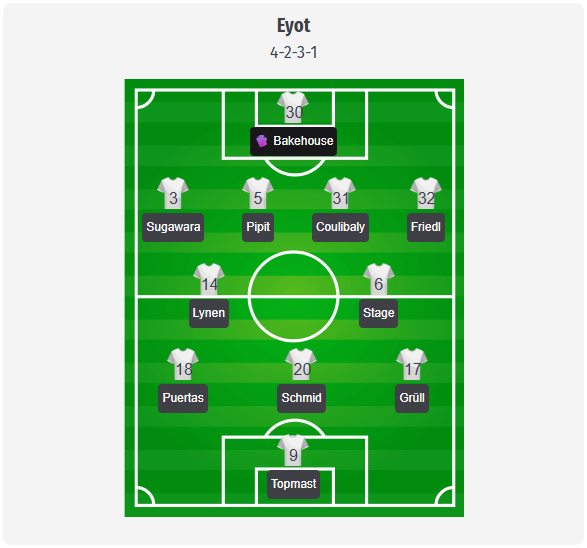
Werder Bremen are likely to line up in a 4-2-3-1 system under Horst Steffen, with Backhaus in goal, Sugawara, Pieper, Coulibaly, and Friedl in a back four, Lynen and Stage as double sixes, and Puertas, Schmid, and Grüll as an attacking trio behind lone striker Topp.
Defensive concerns remain, as Felix Agu, Maximilian Wöber, and Julián Malatini are still unavailable due to injury, and Mitchell Weiser is out long term with a cruciate ligament rupture.
On a positive note, according to recent reports, Stage and Mbangula are fit again and could feature for the visitors, which at least gives Steffen additional options in midfield.
HSV – Werder Head-to-head & Statistics
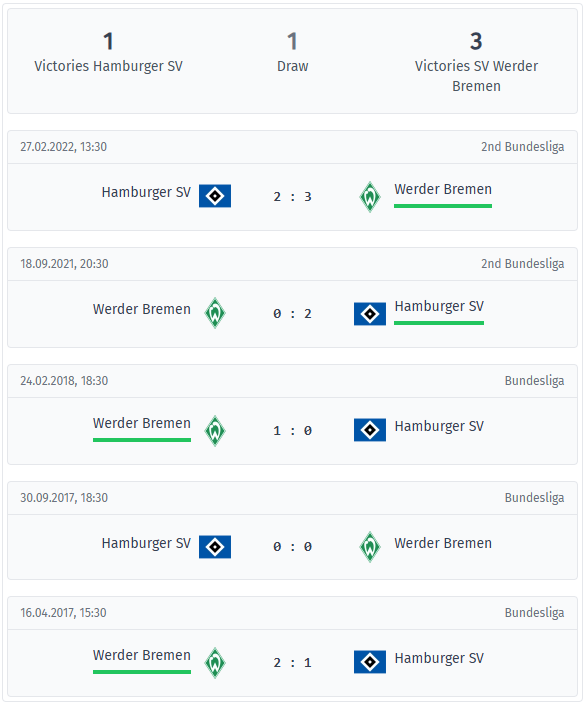
These teams last met in February 2022, when Werder Bremen won 3-2 against Hamburger SV. In the five meetings between 2017 and 2022, Werder won three games, Hamburg won once with an away victory in 2021, and one game ended 0-0 in 2017.
Hamburg has not won a second half in these five encounters, while Werder has shown that they often finish these direct duels strongly.
Tactical trends: Four consecutive games have seen fewer than 1.5 goals scored in the second half, and four consecutive duels have remained under 3.5 goals in total, suggesting rather cautious, defensively oriented encounters.
First-half pattern: Three consecutive games have seen the teams level at the break, highlighting slow starts and early parity in this rivalry.
Context note: The nearly four-year gap since the last meeting and the changes in personnel, tactics, and competition—both clubs are now back in direct competition in the Bundesliga—somewhat diminish the significance of these historical patterns for upcoming games.