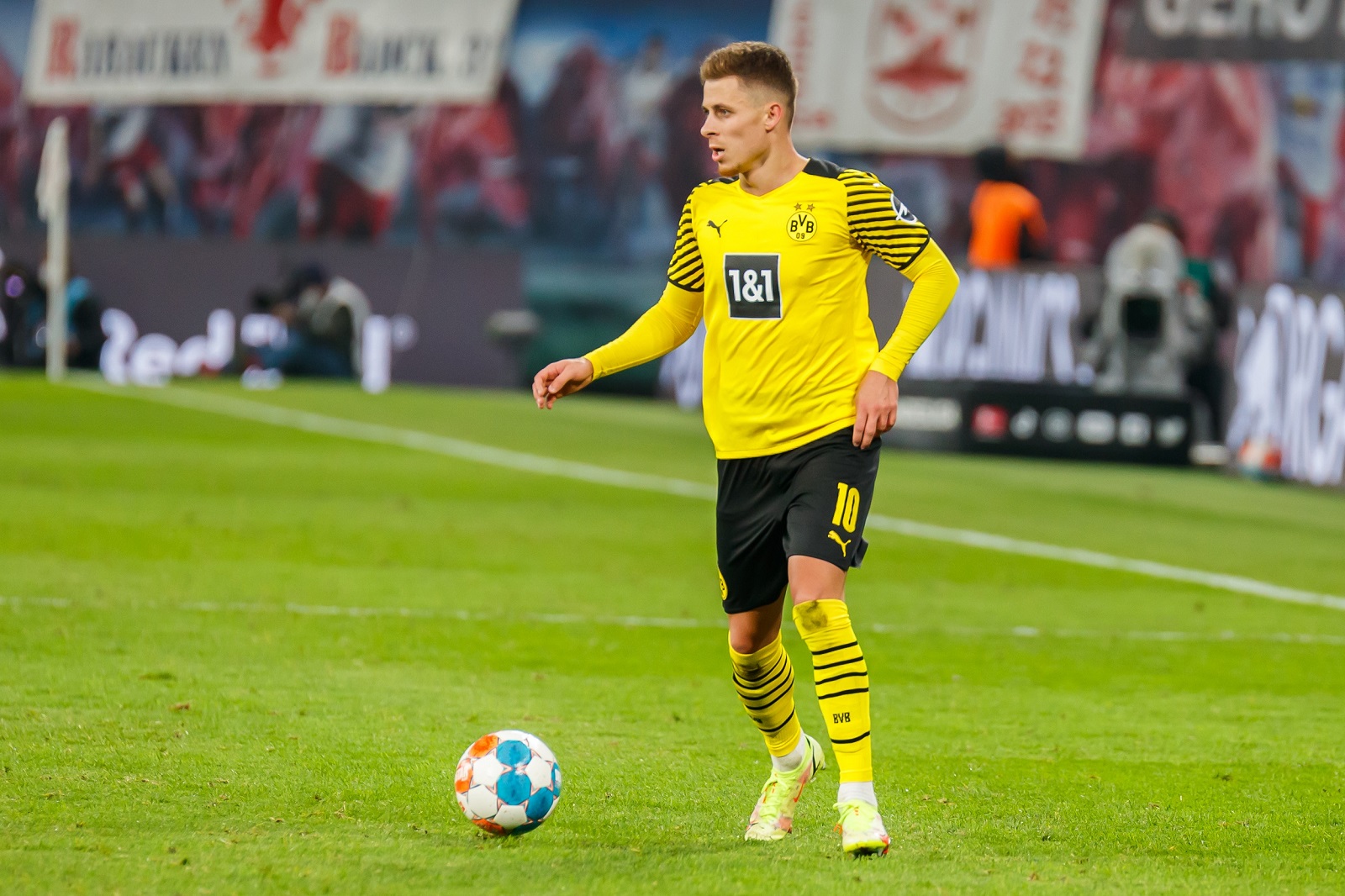
Third-placed Borussia Dortmund welcomes eleventh-placed Borussia Mönchengladbach to Signal Iduna Park for the start of the 15th matchday of the Bundesliga, with Kovac’s team level on points with Leipzig and three points ahead of Leverkusen. After a costly 1-1 draw in Freiburg, in which Bellingham was sent off, and a lackluster draw in the Champions League against Bodø/Glimt, Dortmund owes it to itself to respond decisively, even if the betting market ranks them as clear favorites. Polanski’s team is in the middle of the table with 16 points and a negative goal difference, already falling short of at least one of its stated goals for the season. An away win against one of the top three teams would have a correspondingly large impact on the mood in what has been a disappointing season so far. Historically, Borussia Dortmund’s home games have often been open and high-scoring affairs, with the last meeting ending 3-2 to the hosts, and Gladbach failing to beat BVB in their last five league games. After injuries and absences in defense, Dortmund could rely on Süle alongside Schlotterbeck, while Gladbach is hoping for the return of Scally and Neuhaus, as well as options such as Reyna, who can stabilize a depleted squad.
- Venue: Signal Iduna Park, Dortmund
- Date and time: December 19, 2025, 8:30 p.m.
- Competition: Bundesliga (Matchday 15)
A depleted but still creative Gladbach, strengthened by the return of Neuhaus and Scally, can exploit BVB’s patchwork defense, especially with Anton and Bensebaini missing and a still somewhat rusty Süle likely to start. That suggests goals at both ends and a late away goal.
Dortmund form & record check
In the Bundesliga, Dortmund are in solid but not flawless form. The 2-1 away win at Bayer Leverkusen and the controlled 2-0 win against Hoffenheim suggested a team stabilizing under Niko Kovac, but the 1-1 draw in Freiburg halted that momentum, leaving them in third place with 29 points, level with RB Leipzig and three points ahead of Leverkusen. The game in Freiburg summed up some recurring problems: Dortmund took the lead through Bensebaini and largely controlled the game, then an impetuous red card against Bellingham changed the balance, and the late equalizer seemed self-inflicted. A few days earlier, the 0-1 defeat to Leverkusen in the cup revealed similar problems in the final third, with plenty of possession but too little penetration once the opposition dropped deeper. In Europe, the 2-2 draw with Bodø Glimt reinforced the impression that Dortmund are falling short of their potential. With 11 points, they are roughly in tenth place in the new Champions League table, so a direct place in the round of 16 seems unlikely, even if the play-offs already seem secure according to the forecasts. Kehl spoke of overconfidence and Schlotterbeck publicly criticized teammates, a clear sign of internal frustration. Statistically, across all competitions, Dortmund games are rarely uneventful: in four of their last five games, they have both scored and conceded goals, and four times there have been more than one goal in total. Interestingly, their first halves usually remain close, often with no more than one goal, yet Dortmund scores early in most games, while the real instability shows after the break when structure and concentration wane. Personnel unrest further surrounds this form curve. Süle, whose contract the club reportedly does not want to extend, has fallen behind Schlotterbeck and Can, but injuries to Anton and Anselmino, as well as Bensebaini’s absence due to international duty, could bring him back into the spotlight. In midfield, the problems of Sabitzer and Brandt increase the creative burden on Groß, Chukwuemeka, and Bellingham, while Guirassy and Beier remain reliable finishers when chances arise.
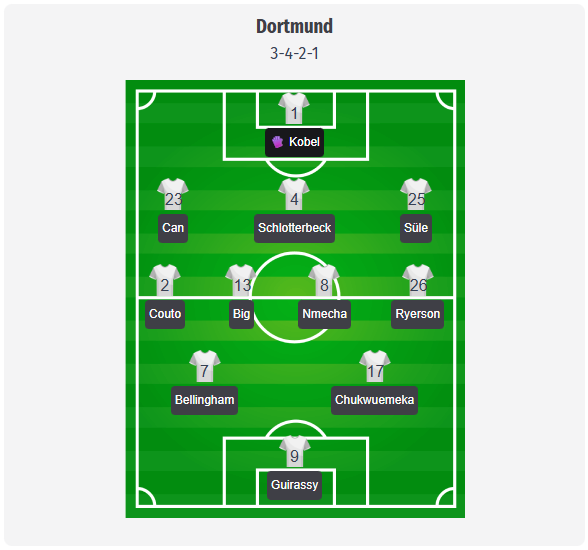
For the home game against Gladbach, Borussia Dortmund under Kovac are likely to stick with their familiar 3-4-2-1 formation, with Kobel in goal behind a back three of Schlotterbeck, Can, and Süle. Couto and Ryerson would operate as full-backs, while Groß and Nmecha occupy the central midfield. Bellingham and Chukwuemeka are expected to support Guirassy as the central striker. These are still predictions, not confirmed lineups. In defense, Anton and Anselmino have thigh injuries, Bensebaini is with his national team, and Mane is ill, which means that the depth behind the back three would be quite thin. Further up front, Brandt is struggling with ankle problems and Sabitzer with muscle tension, so Groß, Nmecha, Bellingham, and Chukwuemeka will likely have to take on most of the creative work behind Guirassy.
Gladbach Form & Record Check
Gladbach travel to Dortmund in mixed form in all competitions. In the league, a convincing 3-0 win in Heidenheim was followed by a solid 0-0 draw against Leipzig and a tough 1-0 away win in Mainz, only to then collapse at home against Wolfsburg, losing 3-1. In the DFB Cup, they were eliminated after a 2-1 home defeat to St. Pauli. These five games have resulted in two wins, one draw, and two defeats, which is consistent with a team in 11th place in the table with 16 points and a negative goal difference. Interestingly, the pattern within the games is more consistent than the results suggest, as Gladbach have scored in four of their last five and have not lost a second half in that run. The first halves have been rather cautious, with four of the last five competitive games remaining under 1.5 goals before the break, suggesting a cautious approach from Polanski. The tactical idea of using Scally as part of a back three was adjusted against Wolfsburg, as Sander took over that role during his suspension and was unable to provide the same dynamism in possession or stability in transition. More broadly, the contrast between away resilience and home vulnerability defines their current league record: Strong wins in Heidenheim and Mainz contrast with the passive performance in the 3-1 defeat to Wolfsburg and the cup exit against St. Pauli. The club has already admitted that one of its goals for the season will not be achieved, which is often linked to its poor home record and tense relationship with parts of the fanbase. Personnel problems further color this picture. Kleindienst, Hack, Honorat, Ngoumou, and Urbich are out in attack, while Chiarodia and Friedrich are missing in defense, so Polanski is currently relying more on Tabakovic, Machino, and flexible options such as Reyna or Ranos. The return of Neuhaus and the reintegration of Scally should improve their structure in possession and give the team more composure under pressure.
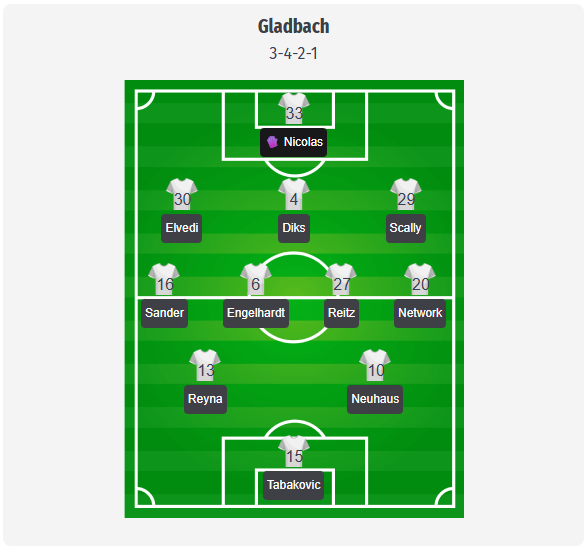
Gladbach are expected to line up in their now familiar 3-4-2-1 formation under Polanski, with Nicolas in goal behind a back three of Diks, Elvedi and the returning Scally, fresh from his league suspension. Netz and Sander should operate as wingbacks, while Engelhardt and Reitz provide stability in central midfield, with Chiarodia and Friedrich missing and alternatives in central defense remaining limited. In the more attacking areas, Neuhaus, recently returned from muscle problems, is expected to start alongside Reyna as a more advanced midfielder, behind Tabakovic, who would continue to play as the lone striker. Options on the wings are thin, with Honorat, Hack, and Ngoumou out and Kleindienst and Urbich also unavailable. Machino, who was absent at the start of the week, could only come off the bench. This is a predicted lineup, not an official confirmation.
Dortmund – Gladbach Head-to-head comparison & statistics
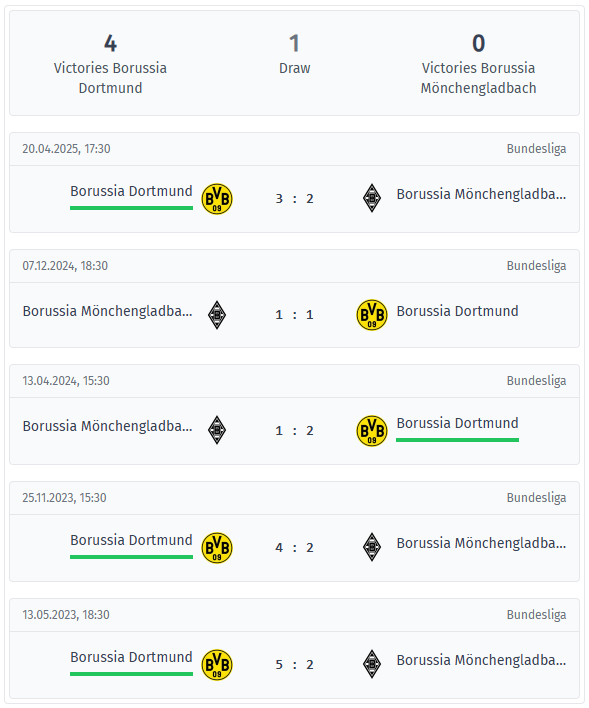
Dortmund are unbeaten in their last five Bundesliga encounters since 2023, with four wins and one draw against Mönchengladbach. The most recent match in April 2025 ended 3-2 in Dortmund’s favor after they once again made the difference up front, despite conceding twice, with the current balance clearly tilting in favor of Niko Kovac’s team. The home advantage was clear: in 2023 and again in April 2025, Dortmund hosted Gladbach three times and won 5-2, 4-2 and 3-2, always scoring at least three goals and conceding two. In contrast, the two trips to Mönchengladbach in 2024 resulted in a narrow 2-1 away win and a 1-1 draw, so the gap outside Signal Iduna Park is narrowing. The encounters were consistently high-scoring. A total of 23 goals were scored in the five games, 15 for Dortmund and 8 for Gladbach, an average of 4.6 per game. All games exceeded 1.5 goals and four ended with at least three goals. Both teams scored in all five games, so there was no game in this recent series in which one team kept a clean sheet. Another clear pattern emerges around halftime: Dortmund led at halftime in four of the five games and never trailed, while Gladbach failed to score before the break during this period. Gladbach’s goals all came after halftime, suggesting that the games open up later on after Dortmund has established itself early on. During this period, Dortmund racked up a series of three wins from 2023 to the first meeting in 2024, which naturally meant three consecutive defeats for Gladbach. Combined with the current five-game unbeaten streak and five consecutive meetings in which both teams have scored, the psychological advantage could now firmly lie with Dortmund ahead of the next chapter.