There are currently only 10 points separating a team dreaming of European qualification and a club embroiled in a relegation battle, and it is precisely this tension that will be on display when Brighton take on West Ham at the Amex Stadium. Brighton are seventh in the table with 22 points and want to establish themselves firmly in the top half of the table, while West Ham, in 18th place with 12 points, desperately need some breathing space at the bottom of the table. The contrasts in form are clear: Brighton are entertaining in attack but have repeatedly shown defensive weaknesses, while West Ham struggled for a long time but have at least gained some momentum with a draw at Manchester United and a few earlier wins.
There have been plenty of goals in recent head-to-head matches, with four of the last five encounters seeing over 2.5 goals. Typically, the games have started slowly and then opened up significantly in the second half, with the games often being decided in the latter period.
In terms of personnel, Brighton will be without Stefanos Tzimas, who is out long term with a serious knee injury. West Ham welcomes back Lucas Paquetá after his suspension, which could give their creative play and, above all, their transition game a significant boost. Accordingly, Brighton is likely to restructure its midfield and attack without Tzimas, while West Ham will rely more heavily on Paquetá to create chances from winning the ball.
From a tactical point of view, Brighton will try to control the game through possession, keep the wings wide and force the opponent into turnovers through aggressive pressing, which will lead to quick attacks. At the same time, their own vulnerability will force them to remain compact in phases without the ball, especially against West Ham’s counterattacks and the late runs that Paquetá can trigger. West Ham are likely to absorb pressure, strike on the counter and from set pieces, and use their physical presence and directness in the final third to cause Brighton problems when many players push forward.
Brighton will focus primarily on their offense and creative midfielders, who can exploit the space West Ham offers. For the visitors, playmaker Paquetá, Soungoutou Magassa with his recent goal, and all the target men who can win headers and second balls will be crucial. Given the recent head-to-head encounters, there is much to suggest an open game with goals; a cautious prediction would be a narrow home win for Brighton or a draw, around 2-1 or 1-1, with both teams scoring: Yes, a very plausible market result.
- Venue: Amex Stadium, Brighton
- Date and time: 07.12.2025, 3:00 p.m.
- Competition: Premier League (Matchday 15)
Main view: The most obvious tip is Brighton to win. The Seagulls’ home strength and West Ham’s defensive problems make a home win the clearest choice. West Ham’s ongoing defensive crisis and the absence of the suspended Paquetá after his sending-off against Liverpool disrupt the offensive balance and make the team even more vulnerable away from home. As a complementary market, Both Teams to Score: Yes is attractive, as both teams have shown significant defensive weaknesses recently, and West Ham has conceded goals in each of their last games, making a response from the Hammers seem likely even if Brighton dominates the game for long periods.
For live betting, an early approach is interesting, as Brighton tends to get off to a fast start. In about 80% of their games, they show clear dominance in the first half, which creates value in markets such as goals before the break, a lead at halftime, or early over/under lines. The selection is based on the assumption that Brighton will convert their home pressure into goals and that West Ham’s defensive problems will continue. Risks remain in the form of an early tactical change by West Ham, a very defensive approach by the visitors, or Brighton not being consistent enough despite their superiority in front of goal. Therefore, moderate stakes are recommended, and team news, injuries, and suspensions should be checked carefully shortly before kick-off before placing bets.
Brighton Form & Record Check
Brighton are in seventh place, level on points with Manchester United, after a season in which offensive potential and recurring defensive vulnerability have been closely matched. Their last five league games have yielded three wins, one draw, and one defeat, but this record masks a tendency to concede avoidable goals, particularly during periods when Brighton are clearly dominating possession and creating chances.
This pattern was particularly evident in the 4-3 home defeat to Aston Villa, when a 2-0 lead was squandered as Villa exploited the space behind the high defensive line and pressing structure, including a goalkeeping error that went unpunished. Previously, a solid 2-0 away win at Nottingham Forest and a 2-1 home win against Brentford had provided stability, along with a goalless derby at Crystal Palace, in which Brighton controlled the game without scoring the decisive goal.
Patterns and personnel problems reinforce each other: Brighton often start cautiously, with less than 1.5 goals scored in the first half in four of their last five games, while they become much more dangerous after the break, scoring in the second half in four of those five games. They have scored in five consecutive league games, but have also conceded in four of them, showing that they are currently trading goals rather than completely controlling games. Tzimas’ serious knee injury, which will keep him out for months, is a major setback. With Danny Welbeck as the only established center forward and Georginio Rutter able to step in as a false nine, the club is considering bringing Evan Ferguson back from his loan at Roma rather than signing an external replacement in January.
Defensively, the situation remains challenging: Adam Webster is still out long-term with a cruciate ligament injury, and although Lewis Dunk recently reached the 500-game mark, the defense remains vulnerable to opposing midfielders who push into the space behind the back line. Fabian Hürzeler’s high line and aggressive pressing create chances, but at the same time leave spaces that opponents can exploit. If the push for Europe from seventh place is to succeed, the coach must find a better balance between pressing intensity and defensive compactness.
In the short term, bringing Ferguson back would be a good way to broaden the offensive options and cushion the loss of Tzimas. In addition, the pressing triggers should be adjusted to push opponents further out of the central corridors and make it more difficult for them to break through the midfield. In games with many potential transition situations, such as against teams with fast midfielders, a slightly deeper defensive line or more conservative coverage across the width of the pitch can help. At the same time, set pieces and situational defensive phases need to be better organized to avoid giving up leads through avoidable goals.
Brighton thus remain an offensively minded, attractive team that can score regularly, but the rest of the season will depend heavily on whether the transitional defense can be stabilized and the loss in attack compensated for, so that their good form is not repeatedly destroyed by defensive lapses.
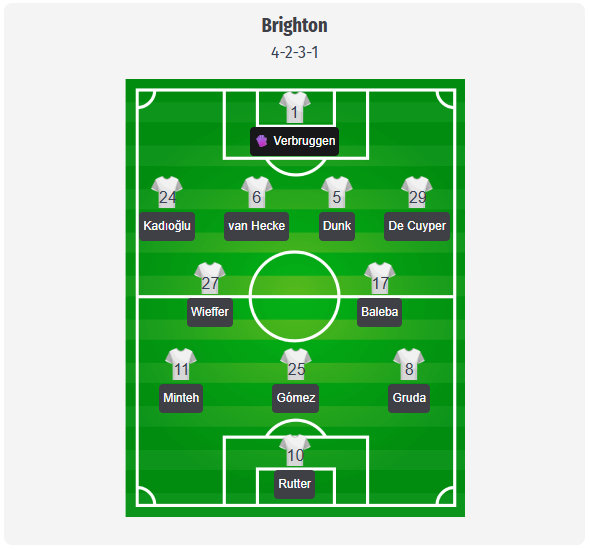
Brighton are expected to stick with their usual 4-2-3-1 formation, but Stefanos Tzimas’ serious knee injury is likely to see Georginio Rutter take over the false nine role, with Danny Welbeck the only other classic center forward available.
In the back four, Mehmet Zeki Çelik Kadıoğlu is expected to start on the right, Lewis Dunk and Jan Paul van Hecke in the center, and Arthur De Cuyper on the left, a combination that should combine defensive stability with the technical quality to build the game cleanly from the back.
In the double six, Carlos Baleba and Mats Wieffer are likely to secure the center, providing protection for the defense while also carrying the ball forward through the middle.
Behind the striker, an attacking trio of Yankuba Minteh on the right, Diego Gómez on the left, and Brajan Gruda in the central number 10 role are expected to support Rutter, with Gruda acting as the creative link and Minteh and Gómez providing width and directness.
In terms of absences, Adam Webster remains sidelined long-term with a cruciate ligament injury, while Solly March and James Milner are also unavailable, further increasing the reliance on younger attacking players and Rutter in the false nine role.
West Ham Form & Record Check
West Ham are in 18th place with 12 points from 14 games, level on points with Leeds on goal difference and just two points ahead of Burnley. Under Nuno Espírito Santo, they have recorded two wins, two draws, and four defeats in eight Premier League games. Recent form suggests short-term offensive potential, with wins against Newcastle and Burnley and goals in four of their last five league games, but at the same time, the defense remains unstable, with West Ham conceding goals in all five of their most recent league games, four of which came in the second half. Every Hammers game recently has had over 1.5 goals.
Key problems lie in defensive instability and lapses in concentration or fatigue after the break, leading to late goals conceded. The ongoing inability to keep clean sheets undermines any offensive progress. Added to this are Lucas Paquetá’s emotional and form-related difficulties following the spot-fixing investigation, and his sending-off against Liverpool further disrupted the lineup and balance in midfield. Up front, Niclas Füllkrug is still waiting for his first goal and seems keen to leave, while Callum Wilson is an option but carries a clear injury risk. To make matters worse, upcoming matches against Brighton, Aston Villa, and Manchester City further reduce the margin for error.
There are clear priorities for the next 4 to 8 games: the defense must be stabilized with a simplified defensive formation, tighter transition play, and better protection of the wide areas, where late breakthroughs often occur. Set pieces and foul discipline should be given greater focus to avoid collapses in the second half. Work needs to be done on physical fitness and more targeted rotation to reduce slumps in the final stages, for example through better regeneration and earlier substitutions to stop negative momentum shifts. Paquetá should be carefully reintegrated and protected, with a reduced creative load if necessary and a clearly defined defensive midfielder to cover him in front of the defense. In attack, a clear short-term plan is needed that emphasizes Jarrod Bowen’s strengths, quick transitions and runs into the middle, and crosses or back passes that allow a striker type to capitalize on second balls, rather than relying exclusively on classic hold-up play. Tactically, against stronger opponents, a compact midblock with a tight five-man midfield is a good option to limit space between the lines, while against weaker teams, a higher press can be used to force quick ball wins.
From a coaching perspective, it would make sense to switch to a more conservative basic formation as soon as a lead needs to be defended, such as a 4-2-3-1 or 4-3-3 with two deep-lying midfielders to limit the consequences of late goals. In addition, earlier substitutions could help to change the pace of the game between the 60th and 75th minutes, when many goals are currently conceded. It is also important to improve defensive communication and clear leadership in defense by pairing experienced defenders and assigning one player explicit responsibility for organizing set pieces and counterattacks. Pressing triggers should be adjusted so that West Ham is no longer so easily counterattacked in the late stages of games when switching play.
In the January transfer window, budget permitting, a reliable defensive center back and a defensive midfielder are at the top of the list, ideally players who can help immediately and improve organization, rather than long-term projects. Füllkrug’s form and morale should be critically examined, and if he is not contributing, a departure should be planned in order to bring in a striker who is better suited to the counter-attacking style of play. Paquetá’s mental state also remains an issue; sports psychology support could help to restore his confidence and focus.
The club’s goal threat keeps West Ham in many games, but as long as the slumps in the second half are not remedied and a more stable defensive formation is not found, it will be difficult to move up the table. The next block of games will be crucial: avoiding defeats and collecting points, especially at home, could stabilize the situation, while further setbacks would intensify the relegation battle and significantly increase the pressure on the coach and the decisions to be made in January.
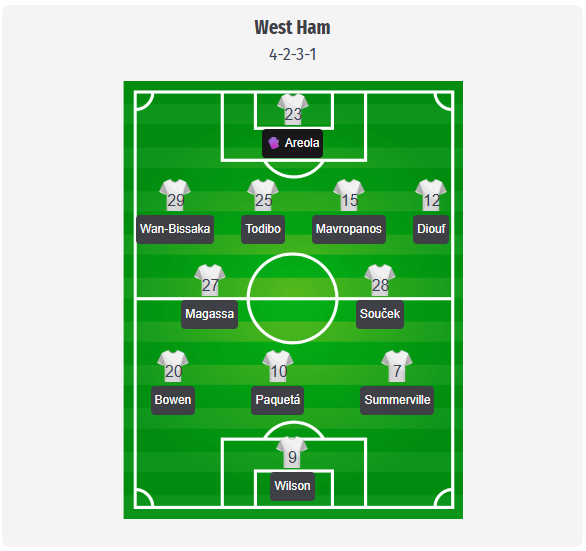
West Ham are likely to start in a 4-2-3-1 formation, with Areola in goal, a back four of Wan-Bissaka, Todibo, Mavropanos, and Diouf, a double pivot of Magassa and Souček, and an attacking trio of Bowen, Paquetá, and Summerville behind lone striker Wilson.
Areola is expected to start in goal, while Łukasz Fabiański is out with an unspecified back injury and currently has no specific return date.
In defense, Wan-Bissaka and Diouf could take on the full-back roles, while Todibo and Mavropanos form the central defensive axis, contributing both physical presence and build-up play.
In midfield, the duo of Magassa and Souček provide the physical, running base, with Bowen, Paquetá, and Summerville animating the front line and Wilson feeding them with deep passes, crosses, and lay-offs.
One reservation remains with Paquetá, who was sent off against Liverpool and could serve a suspension depending on the date of the game. Nuno Espírito Santo has emphasized that he wants to use Paquetá as soon as he is eligible to play again; if he is suspended or unavailable, Fernandes or James Ward-Prowse would be the obvious alternatives, although Ward-Prowse has not been the first choice recently.
Tactically, this lineup emphasizes defensive stability with the double six and fullbacks, who are expected to provide both security and width, while the three players behind Wilson bring creativity and directness to the offensive actions.
Brighton – West Ham Head-to-Head & Statistics
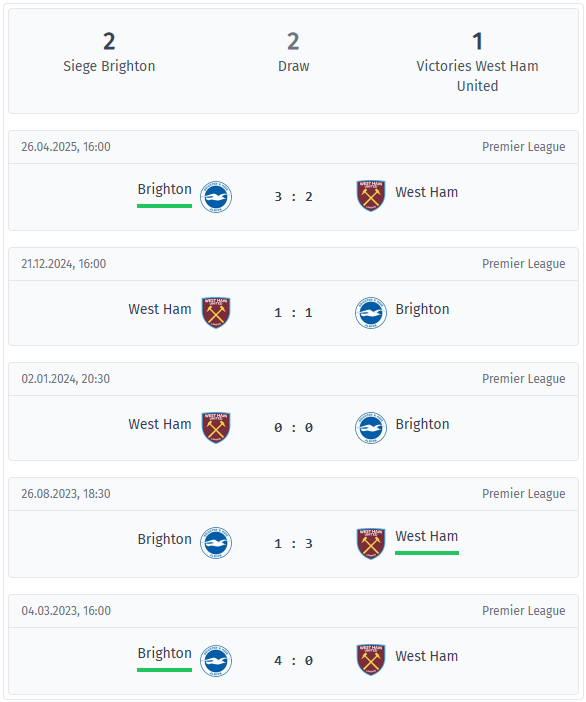
Brighton have had the slight edge in the last five head-to-head matches, with two wins, while West Ham have recorded one win and two matches have ended in draws.
There is a noticeable pattern in these games: in each encounter, fewer than 1.5 goals were scored in the first half, while in four of the five games, more than 1.5 goals were scored in the second half.
Brighton’s most recent victory was a 3-2 win at the Amex Stadium in April 2025, with all five goals coming after the break. Brighton scored in four of those five encounters, and West Ham conceded in 80% of those matches.
West Ham’s only win during this period was a 3-1 victory at the Amex Stadium in 2023. The two draws came in January 2024 and December 2024, the latter ending in a 0-0 stalemate at the London Stadium.
The most decisive result in recent history was Brighton’s 4-0 win in 2023. Three consecutive games with more than 2.5 goals in the second half suggest that this fixture often opens up significantly after a rather cautious first half, so patience is often rewarded.