A struggling AFC Bournemouth, with four defeats in their last five games and only a two-point lead over the relegation play-off spot, face Chelsea at the Vitality Stadium. Chelsea are in fourth place and clearly in a better position, but they have a 3-1 defeat at Leeds to contend with and are nine points behind leaders Arsenal, so they have plenty of questions to answer themselves. The situation is clear: Bournemouth desperately needs points to stop its downward slide, while Chelsea wants to respond immediately in the race for Champions League spots after losing some momentum recently. The last meeting at Stamford Bridge ended 2-2, but Bournemouth has not won a single game against Chelsea in the last five head-to-head matches, which adds to the psychological pressure.
Both coaches will have to make changes in midfield. Andoni Iraola has to compensate for the suspensions of Tyler Adams and Lewis Cook, which weakens Bournemouth defensively and makes the team more vulnerable to second balls and counterattacks. Enzo Maresca, on the other hand, has lost a key figure in his midfield with the suspension of Moises Caicedo and has to reorganize the structure in the center. For Bournemouth, Antoine Semenyo could become a key player with his pace and pressure in transition moments, while Chelsea will need their creative wingers and strikers to break down what is likely to be a very compact Bournemouth defense. Tactically, Bournemouth are expected to sit deeper, wait for counterattacks, and allow Chelsea a lot of possession. If the visitors manage to effectively exploit the open spaces in midfield despite Caicedo’s absence, on paper there is a lot to be said for Chelsea. Nevertheless, a close away game is likely, with results such as 0-1, 1-1 or 1-2 seeming realistic.
- Venue: Vitality Stadium, Bournemouth
- Date and time: December 6, 2025, 4:00 p.m.
- Competition: Premier League (Matchday 15)
On the betting market, Chelsea are clear favorites with odds of around 2.1, which is in line with the current situation. Three league wins in a row, each with at least two goals scored, had noticeably boosted the Blues’ confidence before the defeat in Leeds stopped their run. Bournemouth, on the other hand, is in deep crisis, with four defeats in its last five games and at least one goal conceded in each of those games underscoring its defensive problems. In this constellation, it is hardly surprising that the odds are clearly in favor of the visitors.
It is interesting to look at the halves. According to analysis, Bournemouth collapses after the break, losing around 80% of their recent games in the second half. Maresca, on the other hand, tends to make late and targeted substitutions, which gives Chelsea an extra boost in the closing stages. A bet on Chelsea winning in the second half therefore seems reasonable, especially as Bournemouth often find themselves behind at half-time. At the same time, there are reasons to believe that both teams can score, as Bournemouth has scored in four of its last five games, while Chelsea has repeatedly conceded goals due to Caicedo’s suspension, Colwill’s long-term injury, and several red cards this season.
The personnel situation could reinforce this trend. Bournemouth are not only missing the central duo of Adams and Cook, but also Gannon-Doak and Christie, which limits their rotation options. Chelsea, on the other hand, could see the return of James, Fofana, or Palmer, which would increase the depth of their squad. Added to this are transfer rumors surrounding Antoine Semenyo, who is linked with a possible $65 million move, which could cause additional unrest in the host’s camp. Concrete betting scenarios therefore range from the more conservative option of Chelsea winning, based on form and squad quality, to Chelsea winning the second half, to the riskier combination of Chelsea winning and both teams scoring.
Bournemouth form & record check
AFC Bournemouth is clearly in a downward spiral. At first glance, 14th place with 19 points leaves some room for improvement, but this masks the fact that the team has lost four of its last five league games and only managed a draw against a struggling West Ham. The form curve is currently pointing downwards, and in the lower mid-table in particular, this can quickly come to a head.
Defensively, the problems are clearly visible. Bournemouth have conceded at least one goal in all five of their most recent games, and several in four of them. Around 80% of these games ended with more than 3.5 goals, and in just as many games, more than one goal was scored before the break. In four of their last five games, Bournemouth were already behind at half-time, and around 80% of their games were lost in the second half. This combination of early goals conceded and slumps after the break points to tactical weaknesses as well as mental issues.
The most recent games provide clear examples of this. The 0-1 home defeat to Everton, with the decisive goal scored by Grealish in the 78th minute, showed how few ideas there were in the offensive play. In the 3-2 defeat at Sunderland, Bournemouth squandered a 2-0 lead within around thirty minutes, a clear indication of a lack of game management and control over the rhythm and momentum of a match.
In terms of personnel, Tyler Adams, an important stabilizing influence, will be missing against Chelsea after picking up his fifth yellow card, while Lewis Cook continues to serve his three-match ban following his sending-off at Sunderland. On a positive note, Marcos Senesi and David Brooks are available again after their suspensions. The rotation of the captain’s armband, most recently worn by Antoine Semenyo, shows Iraola’s attempt to distribute responsibility more broadly, so far without the hoped-for lasting stability in the collective.
In the table, Bournemouth is level on points with Brentford in 14th place, with Fulham just two points behind. There is no acute fear of relegation yet, but the momentum is worrying, especially with two difficult tasks ahead against Chelsea and Manchester United. In the short term, a pragmatic approach makes sense, i.e., stabilizing the defensive formation, defining clear leadership roles in communication, sharpening game management, and focusing on damage control against strong opponents in order to rebuild confidence.
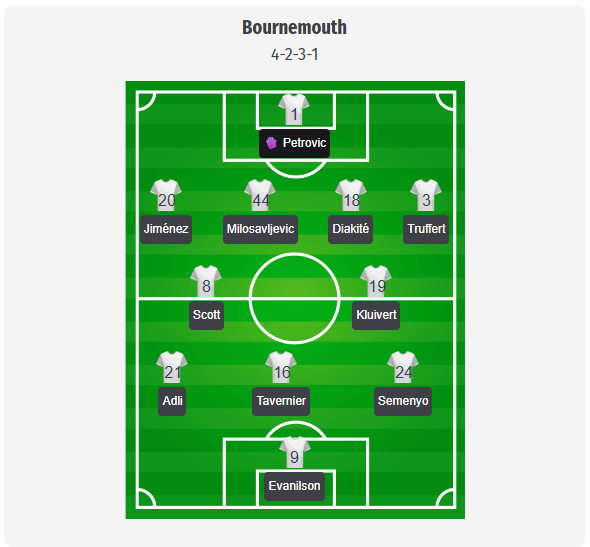
Andoni Iraola is expected to stick with his established 4-2-3-1 system, but will have to cope with several absences. Tyler Adams is suspended after picking up his fifth yellow card, Lewis Cook is still serving his suspension after receiving a red card in Sunderland, and Ryan Christie and Ben Gannon-Doak are also unavailable. On a positive note, Marcos Senesi and David Brooks have served their suspensions and are available again.
In the possible starting lineup in a 4-2-3-1 system, Petrovic could start in goal. In front of him, Jiménez, Milosavljevic, Diakité, and Truffert are conceivable in defense, with Scott and Kluivert in the double six. In attacking midfield, Adli on the left, Tavernier in the center, and Semenyo on the right are options, while Evanilson is expected to lead the line.
Chelsea Form & Record Check
Chelsea are in a good position after 14 matchdays with 24 points, a goal difference of plus 10 and fourth place, but they are feeling the pressure from behind. The last five league games have brought three wins, plus a confidence-boosting 3-0 victory over Barcelona in the Champions League. However, the 3-1 defeat in Leeds has dampened the mood and increased the gap to leaders Arsenal to nine points, while the lead over Crystal Palace is only one point, which means the top third of the table is very close.
The defeat in Leeds once again exposed Chelsea’s problems with consistency and balance. Maresca initially left Reece James on the bench and played Trevoh Chalobah at right-back, while 18-year-old Estevao, who was booked early on and substituted at half-time, started with Leeds already leading 2-0. Such experiments in an away game against a relegation candidate raise questions about risk management, especially as Chelsea have received the most red cards in the league this season. The personnel situation adds to the difficulty: Moises Caicedo is still suspended for three league games after his red card against Arsenal, Roméo Lavia is out with a muscle injury, Levi Colwill is out until June after tearing his cruciate ligament, and there are eight games coming up in December. Maresca himself emphasizes that this period must first be overcome before any serious talk of title ambitions can begin in February or March.
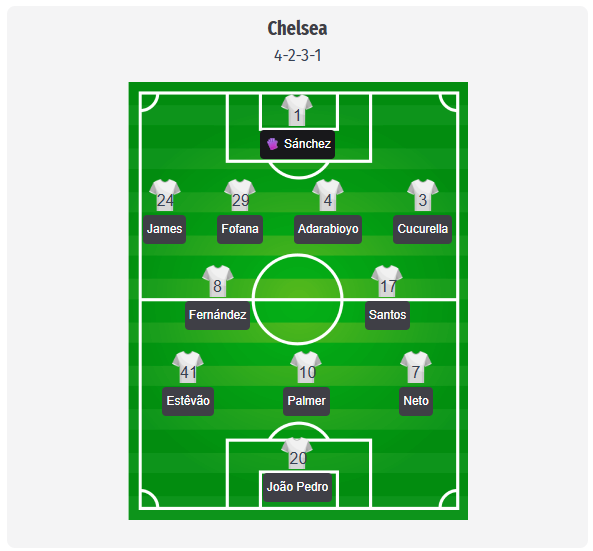
Chelsea are likely to line up in their usual 4-2-3-1 formation, but will have to adjust their central midfield due to the suspension of Moisés Caicedo, the first of three games without him. Andrey Santos could form a double six alongside Enzo Fernández, while Adarabioyo continues to compensate for the long-term absence of Levi Colwill in defense.
Maresca has several options in attack. Cole Palmer could return to the starting lineup after coming on as a substitute in Leeds, alongside Neto and new signing Estêvão behind the striker. Reece James and Fofana are also considered candidates for the starting lineup after Maresca rotated more heavily recently. However, all this remains speculation until the club announces the official line-up.
Bournemouth – Chelsea Head-to-head & Statistics
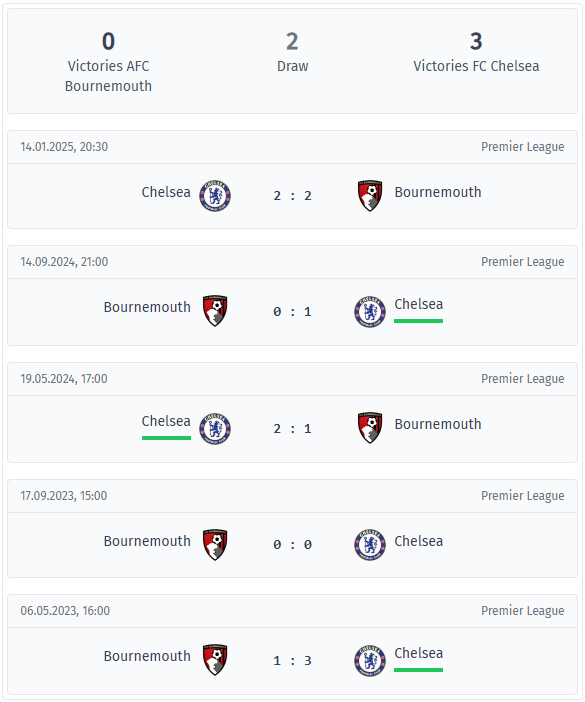
Chelsea are unbeaten in their last five direct encounters with AFC Bournemouth, with three wins and two draws to their name, while Bournemouth are still waiting for a win in this series. The most recent meeting in January 2025 ended 2-2, with Chelsea winning 1-0 in September 2024.
It is striking that the games often remain open for a long time. In four of the last five encounters, there was only one goal scored in the first 45 minutes, with the games usually being decided in the second half. Chelsea scored after the break in four of these five games, while Bournemouth conceded goals after the break in the same number of encounters. The hosts have also struggled at Vitality Stadium, with their last two home games against the Blues ending in a 0-0 draw in 2023 and a 0-1 defeat in 2024. History therefore slightly favors Chelsea and also suggests that late goals, especially in the second half, often prove decisive.