One team is in the thick of the title race, the other is looking to catch up with the leaders, and it is precisely at this juncture that Aston Villa and Manchester United meet at Villa Park on Sunday. Unai Emery’s Aston Villa are in third place in the Premier League, just one point behind Manchester City and five points ahead of Chelsea, with a run of six league games without defeat, all of which they have won, making them clear home favorites for the bookmakers. On the other side, Rúben Amorim’s Manchester United travel to Villa Park in sixth place, chasing momentum for a top-four finish and with the stated goal of backing up their own statements that the club could soon be back in contention for the top spots. Historically, however, the duel tends to favor the visitors, as United are unbeaten in their last five league games against Villa, winning four of them, including a 2-0 victory on the last matchday of last season, and have a total of 41 Premier League wins against Villa to their name. Emery is using these figures as motivation for a team that, according to many metrics, is significantly underperforming, yet has still managed 15 wins from 17 games in all competitions. Both teams are also coming off wild games, with Aston Villa prevailing 3-2 against West Ham, again with a decisive performance from Rogers, while United’s 4-4 draw with Bournemouth exposed their makeshift defense, even as they extended their run of five unbeaten games in all competitions and two consecutive away wins. Amorim will have to plan without the suspended Casemiro and Mazraoui, Mbeumo, and Amad, who are away at the AFCON. Sancho is ineligible to play against Villa, and Martínez is pushing for a comeback after his injury break.
- Venue: Villa Park, Birmingham
- Date and time: December 21, 2025, 5:30 p.m.
- Competition: Premier League (Matchday 17)
At the same time, Amorim’s team’s spectacular 4-4 draw against Bournemouth, combined with Fernandes’ creativity, fuels expectations that both teams will score: Yes, while a cautious, possibly goalless first half seems a plausible scenario against a market that is clearly leaning in Aston Villa’s favor overall.
Aston Villa Form & Record Check
Aston Villa go into the game against United in outstanding league form. They sit third with 33 points, just one point behind Manchester City and with a small cushion over Chelsea, and have built a club-record run of six consecutive Premier League wins under Emery, including a 1-0 win over Wolves, a wild 4-3 win at Brighton, a late 2-1 win over Arsenal, and Sunday’s 3-2 comeback win at West Ham. Across all competitions, Villa have celebrated five wins in a row, including a 2-1 victory in the Europa League at Basel, which preserved their European momentum. The team has scored in each of its last five games and in every second half, which is characteristic of a team that finishes games strongly but remains careless defensively, as in most of these encounters they continued to concede goals and rarely saw out the games comfortably. Overall, they have recorded 15 wins from their last 17 games in all competitions, a run that would put them at the top of the table if you only counted from the end of September. In fact, they are in third place, three points behind Arsenal and one behind Manchester City, so they are fully in the title race. Interestingly, models of expected points for this period only come up with 18, which is about average, underscoring the team’s significant outperformance. On the pitch, Rogers has established himself as a constant goal threat alongside Malen and Buendía, with their goals and assists estimated to be worth 15 points internally, while Watkins, with three goals in 23 games, proves that this run is not being carried by a single center forward. Tielemans dictates the tempo in midfield, Villa regularly scores from distance and has kept results stable despite the injuries to Martínez and Pau Torres, but the upcoming series against United, Chelsea, and Arsenal will show exactly how resilient this form really is.
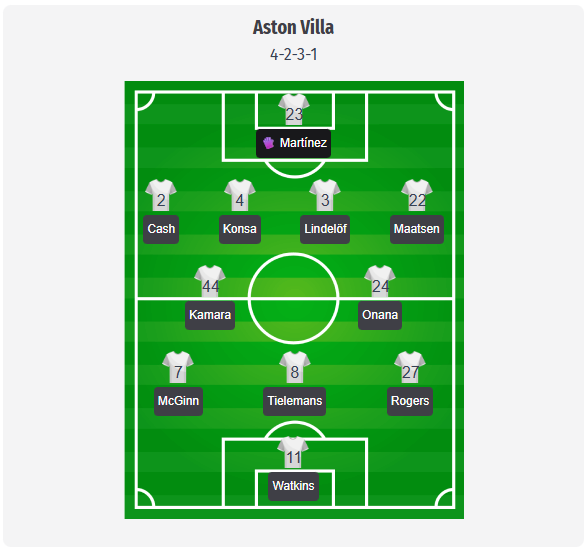
Aston Villa will in all likelihood line up in their usual 4-2-3-1 formation. In the predicted starting lineup, Martínez returns in goal, with Cash, Konsa, Lindelöf, and Maatsen forming the back four in front of him. Kamara and Onana take over the double six, with McGinn and Rogers playing alongside Tielemans as central creative posts behind Watkins, keeping Villa compact without the ball and allowing Rogers and McGinn to repeatedly run into the half-spaces. At the back, the managers are planning without Mings, who is still out with thigh problems, and Pau Torres is being brought back gently after his injury, meaning that the duo of Konsa and Lindelöf are likely to remain together in central defense. Guessand is away with his national team and Sancho is ineligible to play against United, so Buendía and Malen are the most likely options to come off the bench in this scenario. All of this remains a projection and is subject to change, but the system would once again see Kamara and Onana providing cover for a center-back pairing that is still finding its feet, with Tielemans able to pop up flexibly between the lines, Watkins pressing aggressively from the front, and Rogers, in his recent form, acting as an important link between midfield and attack.
Manchester United Form & Record Check
Manchester United travel to Villa Park in their strongest phase under Rúben Amorim so far, with just one defeat in ten games in all competitions, even if their league record continues to look inconsistent. Their last five games include a chaotic 4-4 draw with Bournemouth, a controlled 4-1 win at Wolves, a hard-fought 2-1 victory at Crystal Palace, a laborious 1-1 draw with West Ham, and a lackluster 1-0 home defeat to Everton, although their away form at least is looking increasingly stable. Offensively, Amorim’s project even seems to be slightly ahead of schedule, with United currently boasting the second-best goal difference in the Premier League. In the 4-4 draw with Bournemouth, Amad, Casemiro, Fernandes, and Cunha shared the goals, while the 4-1 win at Wolves impressively showed how quickly they can overwhelm opponents when the pressing works, even if injuries have so far limited how often Cunha, Sesko, and Mbeumo have started together. Defensively, however, the trend is much less reassuring. United have conceded goals in each of their last five league games and have repeatedly given their opponents early chances, which is reflected in the number of goals conceded before halftime. The second halves then often turn into wild affairs with goals at both ends. The switch to a back four against Bournemouth brought more offensive ambition, but also exposed a fragile structure, especially when counterattacks are directed at Leny Yoro and Luke Shaw. Injuries and absences are shaping the overall picture, De Ligt and Maguire have hardly played, Casemiro is now serving a suspension, and Mazraoui, Amad, and Mbeumo are at the AFCON, so Amorim has to rely heavily on Fernandes, Mount, and Ugarte in the center. United are sixth in the table with 26 points, level on points with Crystal Palace and Liverpool, which means that Champions League qualification is still well within reach. Compared to the dreariness of last season, this seems like a slight overachievement in attack and an underachievement in game control. Sir Alex Ferguson’s warning that a title might not be possible again for a decade contrasts with Amorim’s confidence, and the numbers fit right into this tension. United score like a top team, but continue to rely heavily on an aging creative core and lack the defensive consistency of a true contender.
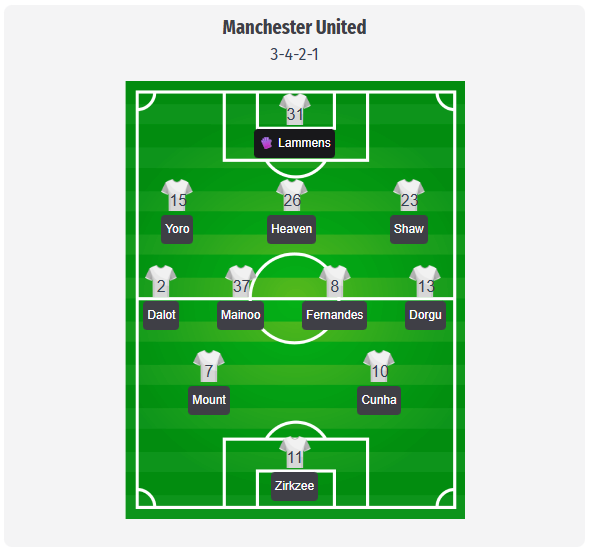
Manchester United are expected to return to Rúben Amorim’s familiar 3-4-2-1 formation. In the predicted starting lineup, Lammens is in goal behind a back three of Yoro, Heaven, and Shaw, while Dalot and Dorgu provide width and depth on the wings. Mainoo and Fernandes are likely to start in central midfield, with Mount and Cunha supporting the expected center forward Zirkzee, who, based on the signals so far, should once again lead the line. This lineup is largely a result of injuries, with De Ligt and Maguire still out, which is why Yoro and Heaven seem to be the obvious choice as the center-back duo. In addition, Mazraoui is at the AFCON. Casemiro’s suspension suggests that Mainoo will start in midfield, and with Mbeumo and Amad also at the AFCON, Fernandes and the duo of Mount and Cunha will carry even more creative responsibility, although Amorim may make a late tactical adjustment.
Aston Villa – Manchester United Head-to-head & Statistics
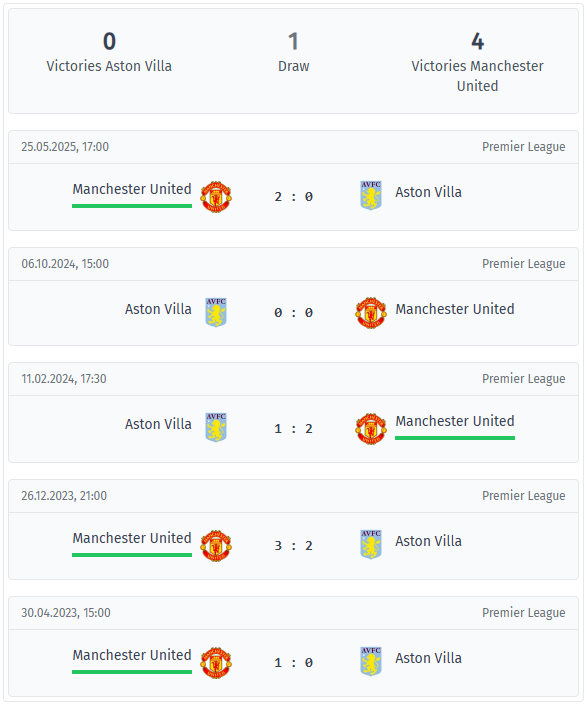
In a direct comparison of the last five league matches from 2023 to May 2025, Manchester United has clearly had the upper hand, with four wins and one draw, while Aston Villa has been unsuccessful, clearly underlining the visitors’ advantage. In terms of numbers, this means that United has won 80% of these games and the duel in recent league history has been clearly one-sided. Home advantage has hardly shifted the balance of power so far, with the two most recent league games at Villa Park ending 0-0 in 2024 and 2-1 to United, also in 2024, meaning Villa have taken just one point at home in this series, while United have remained flawless at Old Trafford with 1-0 and 3-2 wins in 2023 and a 2-0 win in May 2025. In terms of content, these encounters were more close than spectacular, with four of the five games remaining under 3.5 goals and 80% of them seeing under 1.5 goals in the first half. United scored in four of the five duels, while Villa failed to score in two of their last three games during this period, highlighting the greater firepower of the visitors in this pairing. United were particularly dominant in 2023 and 2024, when the team won three league games in a row against Villa, each time scoring goals and ultimately defeating their opponents. It is precisely this streak, combined with an overall win rate of 80%, that points to a psychological advantage, while Aston Villa continues to search for a way to finally break this pattern.