In a sold-out Mendizorroza, Deportivo Alavés, currently in 14th place with 18 points, will face 19th-placed Oviedo, for whom the pressure of relegation is becoming more noticeable with each passing week. Coudet’s team has earned 14 of its 18 points at home, which has proven to be a real shield, while Almada, four points behind safety and only one point ahead of bottom-placed Levante, has virtually no room for another setback. However, Alavés are coming off a heavy 3-0 defeat at Osasuna and have lost four of their last five league games, shaking their previously stable home form. Oviedo are without a win in five La Liga games and have scored just seven goals all season, but they stabilized defensively with a 0-0 draw against Celta, although they remain well below the expectations raised in August.
The head-to-head record also suggests a close game, with the last league meeting in the Segunda ending 1-0 to Oviedo and every encounter remaining under 3.5 goals. Alavés will once again be without the suspended Garcés and Parada, while Díaz and Diarra are also out on disciplinary grounds and Boyé remains doubtful. Oviedo is rebuilding its offense after the departures of Rondón and Dominguès, and although bookmakers see Alavés as the favorite in a sold-out Mendizorroza, they also give considerable weight to a draw.
- Venue: Estadio Mendizorrotza, Vitoria-Gasteiz
- Date and time: January 4, 2026, 6:30 p.m.
- Competition: La Liga (matchday 18)
Interestingly, the tips for Deportivo Alavés to win, under 2.5 goals and both teams not to score are essentially based on the same considerations. Mendizorroza is sold out and considered an unpleasant venue for visitors. Alavés has earned most of its points at home and has not conceded a goal there recently, while Oviedo is second from bottom, in the midst of a mid-table shake-up, and continues to look harmless in attack following the departure of Rondón and a long slump.
Alaves Form & Record Check
Deportivo Alavés goes into this round as a somewhat contradictory team. In La Liga, they are in 14th place with 18 points, level on points with Mallorca directly above them and Rayo Vallecano just behind them, so there is little room for error. In the league, they have only won one of their last five games, but across all competitions, they have still managed three wins during this period.
Their recent performances paint a fairly accurate picture of this nuanced situation. At Mendizorroza, they beat Real Sociedad 1-0 and then gave Real Madrid a hard time before narrowly losing 2-1, showing that Coudet’s team can hold its own in controlled, close games. In the Copa del Rey, they won 3-0 away at Portugalete and 1-0 at home against Sevilla, results that suggest the team is more focused when under knockout pressure. The setback in Pamplona, on the other hand, was much more alarming. Alavés kept Osasuna at bay until the 72nd minute, but then collapsed to a 3-0 defeat, with all three goals coming late and raising questions about concentration and energy management. Coudet tried to change the tone at halftime with substitutions such as Calebe and Rebbach, but the structure collapsed as soon as Osasuna increased the tempo in the final stages.
Statistics from the last five games underscore this picture. Alavés scored in four of these encounters and did not draw a single game during this span, meaning that the matches consistently went one way or the other. Each first half ended with fewer than two goals, suggesting a rather cautious start. It seems that Coudet, especially with Garcés suspended and Boyé injured, is clearly prioritizing stability over risk in the early stages.
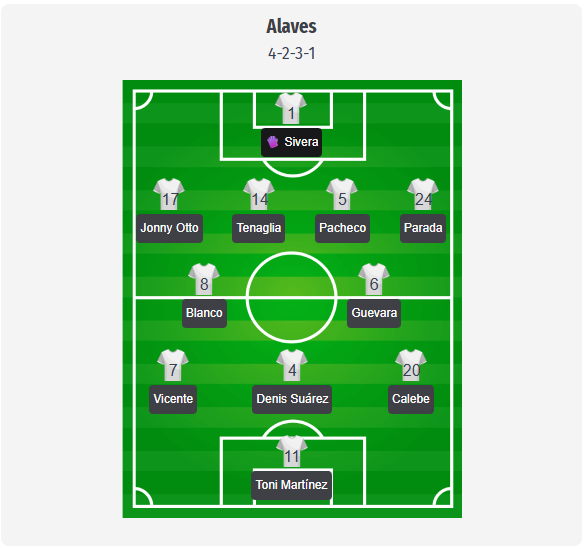
Alavés are expected to line up in their familiar 4-2-3-1, with Sivera in goal and a back four of Jonny, Tenaglia, Pacheco, and Parada. Blanco and Guevara should stabilize the center, while Vicente and Calebe, along with Denis Suárez, will occupy the line behind Toni Martínez. Aleñá and Guridi could also be used in these areas from the start, so the exact offensive structure does not yet seem to be set in stone.
Garcés is missing from the predicted line-up as he remains suspended by the sports court and is not allowed to play in any competition. Pacheco is set to start as the central center-back pairing, with Tenaglia or Parada likely to move inside alongside him if necessary. Up front, Boyé is still out with injury and has no clear return date, which is why Toni Martínez is considered the most likely target man in attack and Mariano remains the most important alternative from the bench.
Oviedo Form & Record Check
Real Oviedo travels to Mendizorroza in clear relegation form. The Asturians are in 19th place in La Liga with 11 points, already four points behind Girona and only one point ahead of bottom-placed Levante, so there is minimal room for error. The season was always going to be a battle for survival, but even by those standards, the combination of poor results and a lack of attacking power has fallen short of expectations.
In league play, the pattern is clear. Oviedo have gone five games without a win, with home draws against Rayo Vallecano, Mallorca, and Celta exposing their lack of cutting edge in the final third. Away from home, they have looked much more vulnerable, with a 2-0 defeat at Atletico Madrid and a 4-0 loss in Seville, and constantly chasing the game seems to be putting additional strain on their defensive discipline.
Interestingly, the statistics from these five league games are extreme. Oviedo failed to score in any of these games and were not ahead at either half-time or full-time. Most second halves ended in draws and with very few chances, which is reflected in a very high proportion of games with under two and a half goals, suggesting a sterile, very low-risk style of play.
Guillermo Almada has tried to provide more defensive stability with Aarón Escandell, one of the positive surprises of this season in La Liga, and the return of David Carmo after his African commitments should further strengthen the defense. However, the real problem remains in attack, where a misfiring forward line, epitomized by Salomón Rondón’s short and disappointing spell, has already triggered a winter overhaul of the offense.
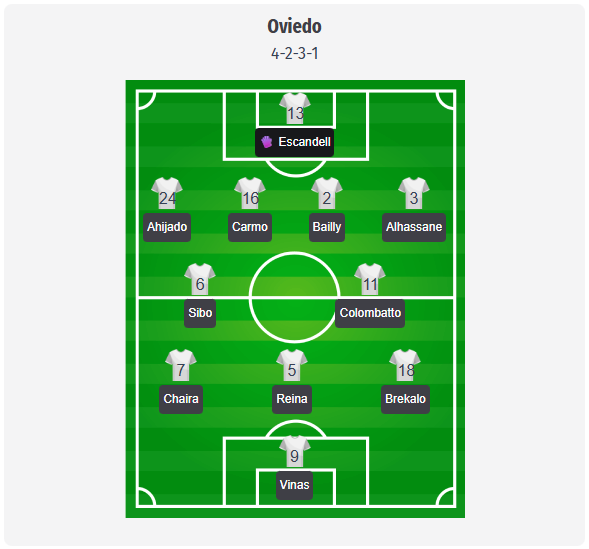
Under Almada, Oviedo is expected to stick with its usual 4-2-3-1 formation, with Escandell retaining his place in goal after his performances as one of the surprises in La Liga. In this predicted system, Ahijado and Alhassane occupy the full-back positions, while Carmo, fresh from the Africa Cup of Nations, forms the center-back duo with Bailly, with Sibo and Colombatto operating as the double six in front of them.
Further forward, Chaira is planned for the left, Brekalo for the right, and Reina between the lines, with all three expected to feed Viñas as the lone striker, especially now that Rondón has left and Forés is on the verge of a move. Nacho Vidal, who is expected to be out until around mid-January with a muscle injury, and Ejaria, who also has a muscle problem with no clear return date, take away some of Oviedo’s natural width.
Alaves – Oviedo Head-to-head & statistics
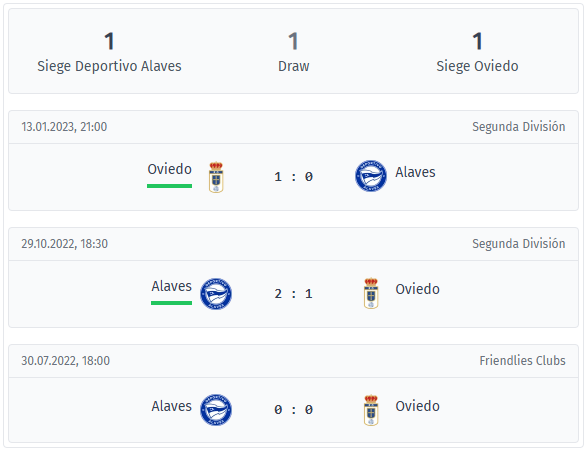
The last three head-to-head matches have been completely even, with both teams recording one win and one draw each, and a total of four goals scored, or two per side.
Each of these games ended with fewer than 3.5 goals, creating a small series of encounters with few goals. The margins were minimal each time, suggesting that the upcoming game is also likely to be characterized by details rather than big swings.
The series begins in 2022 with a scoreless friendly in which neither team really found their offensive rhythm. Later that year, Alavés narrowly won 2-1 at home in the league, and in 2023, Oviedo responded with a 1-0 home win. The home advantage was evident throughout, as the hosts never lost in this short series.
Also noteworthy is a consistent pattern of restraint before the break, with Oviedo yet to score in the first half and Alavés also not conceding a goal during this period, with no more than one goal per game scored before the break. There is much to suggest that early defensive organization will once again be the focus, as previous encounters have tended to be decided late and by very narrow margins.