Key Facts
- With an implied win probability of around 70 percent, Uruguay is the clear favorite, but its recent draws in friendly matches suggest this won’t be a walk in the park.
- Saudi Arabia showed defensive solidity again in the 0-0 draw against Senegal, after the team had previously conceded goals in three consecutive matches.
- Uruguay has won only one of its last five friendlies; Darwin Núñez and Federico Valverde are expected to take on more creative responsibility in the absence of Giorgian de Arrascaeta.
- Uruguay won the only head-to-head matchup 1-0 at the 2018 World Cup, though the controlled nature of the game suggests patience rather than clear dominance.
- A halftime draw is statistically likely, as Uruguay went into halftime tied in four of their last five friendlies.
- Saudi Arabia +1.5 seems reasonable, as Uruguay has rarely won by a large margin recently and de Arrascaeta’s absence could reduce their offensive firepower.
The 2022 victory over Argentina hangs over Saudi Arabia not as a fond memory, but as an unfinished task: Georgios Donis must prove that that evening was more than just a brief moment of glory. On Monday night, Saudi Arabia will open Group H of the tournament—now expanded to 48 teams—against Uruguay at Hard Rock Stadium, which will be known as Miami Stadium during the World Cup. On the other side is Marcelo Bielsa, who is tasked with helping Uruguay make up for their early exit in the group stage in Qatar.
- Venue: Hard Rock Stadium, Miami
- Date and time: June 16, 2026, 12:00 a.m.
- Competition: World Cup (Group Stage – 1)
The bookmakers see Uruguay as clear favorites, with an implied win probability of around 70%, but the more interesting value might lie beyond the simple result prediction. Uruguay went into halftime with a draw in four of their last five friendlies, and Giorgian de Arrascaeta’s injury could dampen their creative spark.
Saudi Arabia Form & Record Check
Saudi Arabia’s last friendly resulted in a respectable 0-0 draw against Senegal—not a performance brimming with offensive conviction, but at least one that showed some defensive organization again. Georgios Donis made significant changes at halftime, bringing on Salem Al-Dawsari, Hassan Tambakti, Moteb Al-Harbi, Abdulelah Al-Amri, and Nasser Al-Dawsari, suggesting that the focus was as much on evaluating players as it was on the result.
In the last five friendlies, the picture looks uneven: a 3-0 win over Puerto Rico sits between losses to Egypt, Serbia, and Ecuador, followed by the draw against Senegal. The defensive problem isn’t just a figment of the imagination, because before the clean sheet, Saudi Arabia had conceded goals in three consecutive matches, and four of the five games saw over 2.5 goals scored. Nawaf Al-Aqidi’s thigh issues are causing additional uncertainty in the goalkeeping lineup.
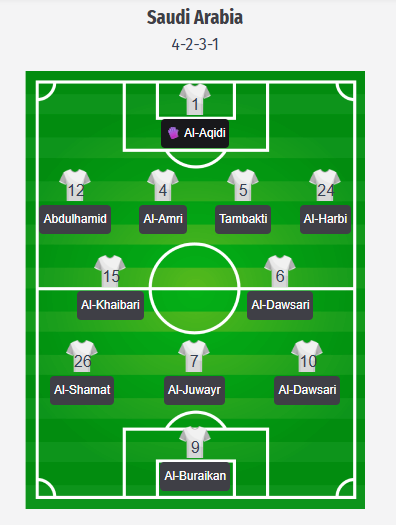
Saudi Arabia could line up in an expected 4-2-3-1 formation under Georgios Donis. The initial assessment had Nawaf Al-Aqidi in goal, but due to the aforementioned thigh issues, Mohammed Al-Owais appears to be the likely replacement. In front of him, Saud Abdulhamid, Abdulelah Al-Amri, Hassan Tambakti, and Moteb Al-Harbi would form a familiar back four. The midfield axis is likely to consist of Abdullah Al-Khaibari and Nasser Al-Dawsari, while Musab Al-Juwayr is expected to link up play further forward. Mohammed Abu Al-Shamat and Salem Al-Dawsari could provide width, with Firas Al-Buraikan slated to play as the central striker. This is a possible lineup, not a confirmed one, but it suggests compactness and quick transitions.
Uruguay Form & Record Check
Uruguay’s most recent outing, a 0-0 draw in a friendly against Algeria in March, fits the current picture: well-organized, competitive, but not yet ready to break down opponents early on. In that match, Marcelo Bielsa gave Ronald Araujo, Federico Valverde, and Nicolás de la Cruz playing time off the bench, which suggests cautious load management rather than a well-rehearsed dress rehearsal. In their most recent friendlies, Uruguay managed just one win in five matches—a 2-1 victory over Uzbekistan—along with draws against Mexico, England, and Algeria, as well as a lopsided 5-1 loss to the U.S. The more noticeable trend concerns their rhythm: during this phase, Uruguay has drawn four first halves. With Giorgian de Arrascaeta unavailable, more responsibility falls on Darwin Núñez and Federico Valverde to convert control into chances.
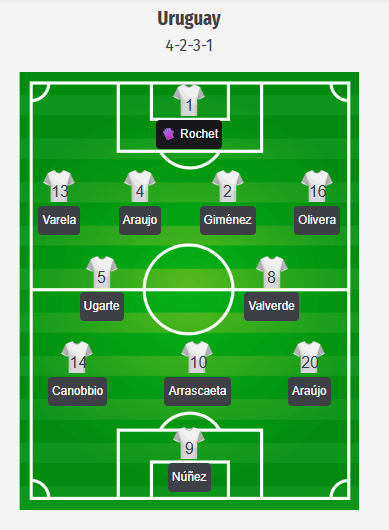
Uruguay is expected to line up in a 4-2-3-1 formation: Sergio Rochet at goalkeeper (No. 1), Ronald Araujo (No. 4) alongside José María Giménez (No. 2) in central defense. Manuel Ugarte (No. 5) and Federico Valverde (No. 8) are expected to anchor the midfield. Giorgian de Arrascaeta (No. 10) is listed as out due to a muscle injury, so Nicolás de la Cruz looks set to be the expected replacement behind Darwin Núñez (No. 9).
Saudi Arabia – Uruguay Head-to-Head & Stats
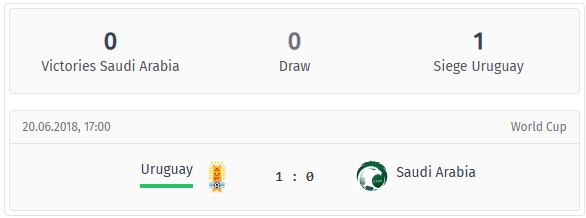
The only available head-to-head match is the group stage game at the 2018 World Cup, when Uruguay beat Saudi Arabia 1-0. What matters here is not so much the result as the course of the game: Uruguay scored before halftime, Saudi Arabia failed to score, and the second half remained evenly matched. This supports the idea of Uruguayan control, but not necessarily a clear victory by a large margin.