Key Facts
- Barcelona leads with 49 points, but Real Madrid is just one point behind; Oviedo is 20th with 13 points and four behind Levante, so both extremes are under pressure.
- Barça are on a four-game winning streak in the league and have scored in their last five competitive games; López’s brace in Prague underlines how strong Flick’s team are after the break.
- Pedri (thigh), Gavi (arthroscopy), and Christensen are out, as is Ferran, leaving the midfield heavily reliant on de Jong’s pace and Olmo’s final pass.
- Oviedo has not won since September 30 and recently let a two-goal lead slip late on at Osasuna; They have conceded goals after the break in four of their last five games.
- At 1.1 on Barcelona, ‘BTTS: No’ and Over 1.5 (2nd half)/Over 3.5 are good bets: Barça have scored in 100% of their last five second halves, while Oviedo have conceded in 80% of theirs.
- In the only recent meeting, Barcelona won 3-1 in September, turning the game around after trailing at the break; the goals were evenly distributed before the break, then over 2.5 goals were scored in the second half.
After an unusually high number of away games, Barcelona is finally back at Camp Nou – and at a time when every point counts at the top of the table. On Sunday, Hansi Flick’s team welcomes Guillermo Almada’s Oviedo in Round 21 for their first home game since December 13. The table is clear: Barcelona leads with 49 points, Real Madrid is one point behind, while Oviedo is in 20th place with 13 points, four points behind Levante. For Barcelona, it’s about maintaining their lead, for Oviedo it’s simply about survival. Barcelona are coming off four league wins in a row, and Wednesday’s 4-2 win at Slavia, sparked by López, has kept their confidence high. There are concerns about Pedri with a thigh injury, and Fernández continues to train separately while his future is being clarified. Oviedo has been winless since the end of September, most recently losing 3-2 at Osasuna, and is once again relying on Escandell. In the recent history of this duel, Barcelona won 3-1 in September, and the betting market also leans heavily toward the Catalans.
- Venue: Camp Nou, Barcelona
- Date and time: January 25, 2026, 4:15 p.m.
- Competition: La Liga (matchday 21)
Barcelona is listed at 1.1, so the market is expecting a clear home win – which makes the details surrounding the final score particularly exciting. Both teams to score: No fits in with Flick’s structure and Oviedo’s straightforward offense, even if Escandell is likely to have a lot to do. After eight consecutive away games, the return to Camp Nou should also increase the intensity. And with Pedri and Gavi missing, Barca often only pick up the pace late in the game, which fits with both over 1.5 goals in the second half and over 3.5 goals in total.
Barcelona form & record check
Barcelona returns to Spotify Camp Nou as La Liga leaders with 49 points, but with Real Madrid just one point behind, there is little room for error even on a weaker afternoon. Things have been going well in the league, with four wins from their last five games, but the recent defeat at Real Sociedad showed that Flick’s team can be forced into rash decisions when their initial pressing is broken down. During the week, they won 4-2 at Slavia Praha in the Champions League and once again showed how strong they can be after the break. López’s brace set the pace, with Olmo and Lewandowski doing the rest. The only downside was the early goal they conceded and, even more worryingly, Pedri’s injury. Three days earlier, the 2-1 league defeat at Anoeta had also exposed some gaps in their transition defense. In the Super Cup, they dismantled Athletic Club 5-0, then narrowly beat Real Madrid 3-2 in the final, a result that underlines both their attacking strength and their habit of inviting pressure after taking the lead. The Copa del Rey trip to Racing Santander ended 2-0, professional if unspectacular.
There have been no draws in their last five games in all competitions, and Barcelona have scored in every game. However, Flick is juggling absences in midfield, with Pedri now joining Gavi on the sidelines and Christensen still missing in defense, so the structure can seem improvised in stretched phases. On the positive side, there is depth in attack with Yamal, Raphinha, Rashford, and Lewandowski, plus de Jong setting the pace. Perhaps the home advantage will also help, because with only a one-point lead, another league slip-up would be costly.
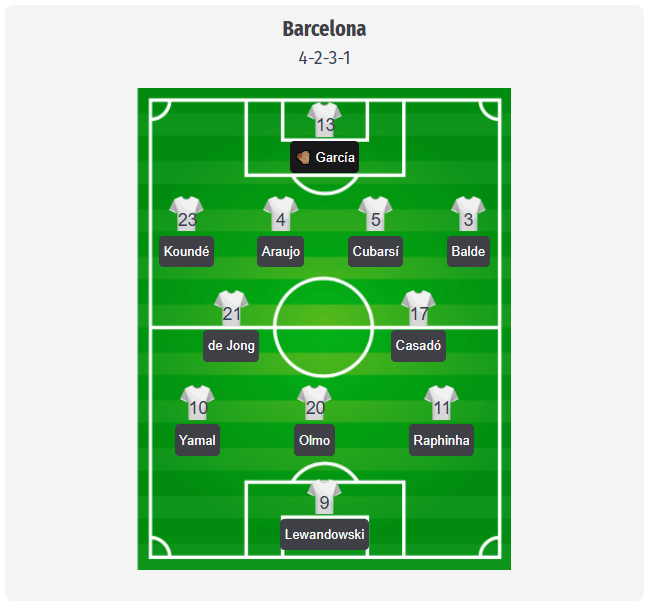
Flick is expected to stick with a 4-2-3-1 formation, with García in goal behind Koundé, Araujo, Cubarsí, and Balde. De Jong is likely to form the midfield base alongside Casadó, with Olmo taking on the role of central playmaker. Yamal and Raphinha should start on the wings to feed Lewandowski. The fullbacks will likely push forward, and the front four will apply pressure early on in their own stadium. One important caveat is the injury list: Pedri is out with a hamstring problem, Gavi is still recovering from arthroscopy, and Christensen remains sidelined, leaving the center heavily reliant on de Jong’s pace and Olmo’s final pass. With Ferran also missing, Rashford looks like the obvious attacking option, while Fermín offers a direct alternative with drive into the box if the game opens up. Cancelo’s restriction only applies in the Champions League.
Oviedo Form & Record Check
Oviedo travels to Camp Nou bottom of La Liga, in 20th place with 13 points, and the table is starting to weigh heavily. Levante, the next team above them, is already four points ahead, so draws are no longer a safety net. They haven’t won in the league since September 30, and they’ve also gone five games without a win. Almada has lifted the mood, but the run continues to weigh heavily. The low point remains the 4-0 defeat at Sevilla, a game in which the defense never settled and the midfield couldn’t slow down the transitions. They responded with a 0-0 draw against Celta Vigo, which looked organized and patient, but at the same time showed their offensive weakness: too few runs behind the ball and too little danger when the game demanded initiative. Consecutive 1-1 draws at Alavés and at home against Real Betis kept the results respectable, but felt like missed opportunities. Oviedo fought solidly for long stretches and limited clear scoring chances, but the final pass was often rushed and set pieces were not exploited. Their games are often even at halftime, possibly intentionally, but they fade after the break. Last week’s 3-2 loss at Osasuna sums up the problem: two leads, a lot of fight, then a collapse in stoppage time. Viñas and Reina scored the goals, Hassan and Luengo provided the assists, but concentration lapsed late on, with goals conceded in the second half in four of the last five games. Escandell has faced 97 shots, and his 8.32 in expected goals prevented shows how often Oviedo is forced onto the defensive. Ejaria is out, and Fernández is ineligible to play.
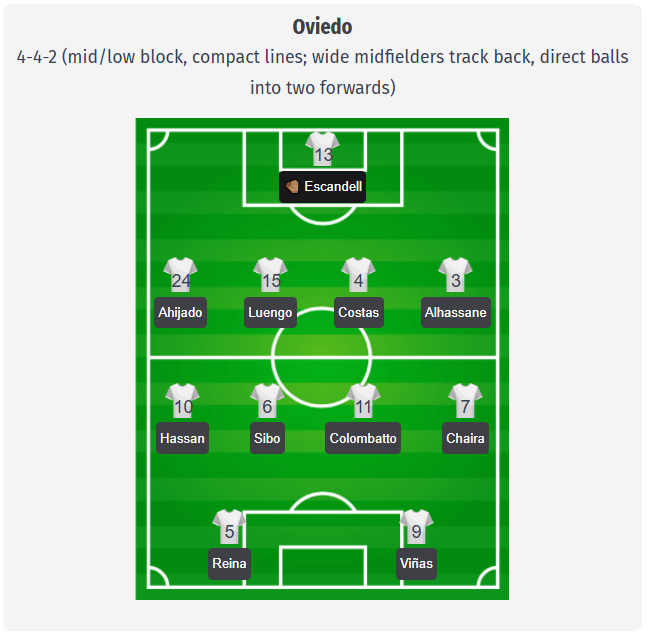
Almada is likely to stick with a 4-4-2, with Escandell behind Ahijado, Luengo, Costas, and Alhassane. The midfield line should be Hassan and Chaira on the wings, with Sibo and Colombatto in the center. Up front, a duo of Reina and Viñas is expected, with Reina dropping back to link up play and Viñas attacking the penalty area. Vidal and Calvo will provide cover in case there is a late change in defense. Tactically, it should be a block between midfield and defense with compact lines, with the wide players tracking runners and initiating counterattacks early. With Fernández ineligible and Ejaria out injured, the wings look set, unless Cazorla is used to bring more control. If more bite is needed in the center, Dendoncker is the obvious option from the bench.
Barcelona – Oviedo Head-to-Head & Statistics
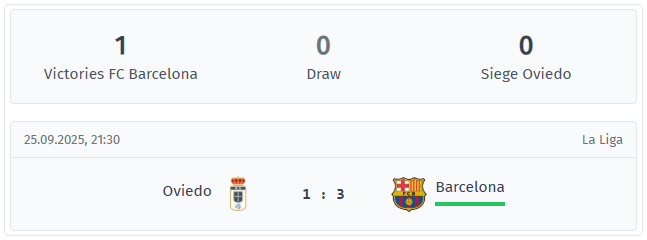
The most recent head-to-head match took place in September 2025, when Barcelona won 3-1 away at Oviedo in La Liga. What was striking was the change in the course of the game: Barcelona actually lost the first half and took complete control after the break. Oviedo scored before halftime but couldn’t find an answer in the second half, while Barcelona brought the game to a routine conclusion. With only one recent encounter, any pattern is marked with an asterisk, but the breakdown by halves is still meaningful. The first half remained relatively tight in terms of goals, with under 1.5 goals, but the game opened up significantly after the break, with over 2.5 goals in the second half. Overall, more than 3.5 goals were scored, suggesting that the decisive moments came late rather than early.