Liverpool are in 4th place under Arne Slot and have worked their way back into the top four with 32 points, but with only a two-point lead over Chelsea, they cannot afford any slip-ups. On the other hand, Daniel Farke’s promoted Leeds are in 16th place with 20 points, seven points above the relegation zone, but they are not really safe yet. These clubs have caused chaos recently, with the return leg at Elland Road ending 3-3 just 24 days ago, Ao Tanaka scoring the equalizer in the 96th minute after Liverpool had led twice. In the last five league meetings, Liverpool have won three and Leeds one, with every game ending with at least a two-goal difference, including 6-0 and 6-1 thrashings and Leeds’ surprise 2-1 win at Anfield in October 2022.
Liverpool go into this game on the back of four wins in all competitions, with Wirtz having scored his first goal and Ekitike leading the attack with eight goals, while Salah is away on international duty and Isak is out injured. Interestingly, a title defense marked by six defeats and weaknesses from set pieces raises questions despite the departure of coach Aaron Briggs. Leeds’ unbeaten run in the league and their set-piece sharpness through Calvert-Lewin come up against a Liverpool side that has already been punished several times from set pieces, so the bookmakers’ inclination towards a home win may be overly optimistic.
- Venue: Anfield, Liverpool
- Date and time: January 1, 2026, 6:30 p.m.
- Competition: Premier League (Matchday 19)
Our tips pick up on several of these lines. While the bookmakers rate Liverpool as clear home favorites at around 1.6, the four home wins in a row at Anfield Road and the growing influence of Ekitike and Wirtz certainly justify a bet on a direct home win, but the real value lies in expecting chaos rather than a calm performance.
The recent 3-3 draw in Leeds and the habit of both teams to turn up the heat after the break argue in favor of Both Teams to Score: Yes and Over 1.5 Goals in the Second Half. These very factors play into Farkes’ reactive adjustments and Liverpool’s late pressure, and run slightly counter to a market narrative that tends to underestimate Leeds’ ability to strike at Anfield.
Liverpool Form & Record Check
Across all competitions, Liverpool enter the new year on a quietly impressive run, unbeaten in five games with four wins and a draw. Since the chaotic 3-3 draw at Elland Road, they have won 2-1 away at Tottenham, beaten Brighton 2-0 at Anfield, scraped a 1-0 win at Inter in the Champions League, and then withstood late pressure to win 2-1 at home against Wolves. Their performance curve seems steady rather than spectacular; they have scored in each of these five games, mostly after the break, and the data shows that Liverpool have scored in the second half in four of their last five games, while the first halves have been tight, often yielding fewer than two goals, suggesting that Slot prioritizes control first, then fitness advantages.
Defensively, the picture remains worrying, especially in the league. Liverpool have already conceded six defeats and 26 goals in 18 games, a remarkable 12 from set pieces and seven from corners, the worst record of its kind in the top five leagues. Leeds and Wolves both punished sloppy second phases in the build-up, with Tanaka and Bueno scoring, and the departure of set-piece specialist Briggs underscores the magnitude of the task Slot has to solve here.
Structurally, the team is still adjusting to life without Alexander-Arnold, whose passes, as Gerrard put it, made Liverpool less predictable. Now, creativity flows more strongly through Wirtz between the lines, with Szoboszlai and Gravenberch driving the game forward from midfield, while Ekitike carries much of the league goal-scoring burden with eight goals and two assists. With Salah away on international duty and Isak out injured, this attacking balance is effective but not yet ruthless.
In the table, Liverpool are in 4th place with 32 points behind Arsenal, Manchester City, and Aston Villa, seven points behind Villa according to current analysis, with Chelsea just two points behind. Predictions now give Slots’ team only a very slim chance of winning the title, around 1%, but they still see them as strong contenders for a top-five finish. Their current form in the league is solid, but their ongoing weaknesses from set pieces make every result seem fragile.
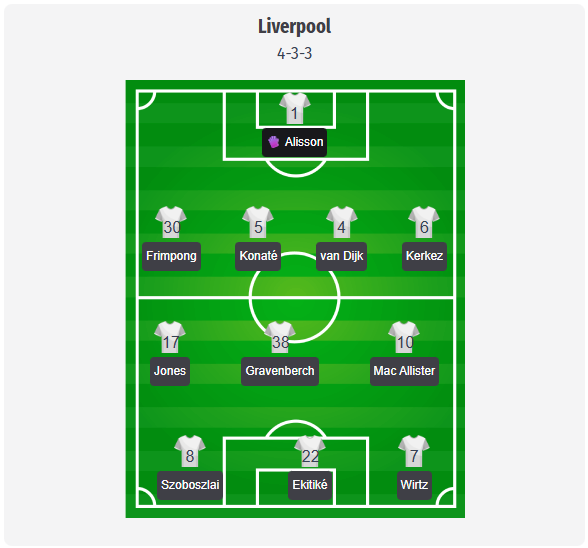
Liverpool are expected to stick with their familiar 4-3-3, and the predicted starting lineup is in line with recent reports: Alisson; Frimpong, Konaté, van Dijk, Kerkez; Jones, Gravenberch, Mac Allister; Szoboszlai, Ekitike, Wirtz. Mac Allister anchors the midfield, Jones and Gravenberch push forward, while Szoboszlai and Wirtz tuck in around Ekitike. Konaté and van Dijk are not only important in build-up play, but are also expected to stabilize a defense that is vulnerable to set pieces.
Absent players dominate this predicted lineup. Salah is away with his national team, and Isak, Gakpo, Endo, Bradley, and Bajcetic are all out, limiting rotation in attack and at right back. Frimpong could be pushed very high up to replace some of Salah’s threat, while Wirtz moves more inside. It remains a prediction, and a late change in midfield or on the wings would not be surprising.
Leeds Form & Record Check
Leeds travel to Anfield in quietly encouraging form. They are 16th in the table with 20 points, three behind Bournemouth and only two ahead of Nottingham Forest, so their margin of safety is slim but noticeable for a newly promoted side. After a poor November, a run of five games without defeat has pushed them out of the immediate relegation battle, but they cannot afford to relax now. The results of this run speak for themselves: Leeds beat Chelsea 3-1, then played out a thrilling 3-3 draw with Liverpool at Elland Road, earned a 1-1 draw at Brentford, swept Crystal Palace aside 4-1, and came from behind to draw 1-1 at Sunderland. In each of these games, both teams scored and at least two goals were scored, showing how open and nerve-wracking their games remain.
Tactically, Daniel Farke’s switch to a 5-3-2 formation has provided more stability, without solving all the problems. Joe Rodon anchors the back three, allowing full-backs such as Jayden Bogle and Sam Byram to push forward, making Leeds look more secure positionally. Their expected goals per shot have increased slightly, and it could be that this system is finally better suited to the physical profile of the squad.
In the final third, Dominic Calvert-Lewin is driving this upturn, scoring in six consecutive league games, seven goals in that period, and looking revitalized since his move from Everton. Brenden Aaronson’s creativity has increased, with three assists in his last seven league games and an outstanding performance at Sunderland. Together, they embody a team that is exceeding offensive expectations but continues to be handicapped by its inability to keep clean sheets.
A clear pattern is emerging within the games, with data from the last five league games showing that Leeds has scored in every second half, never losing those periods, but at the same time regularly conceding goals after the break.
Combine that with a data-driven focus on set pieces, which has already yielded 12 goals this season, and you have a team that is dangerous from dead balls but still learning when it comes to game management.
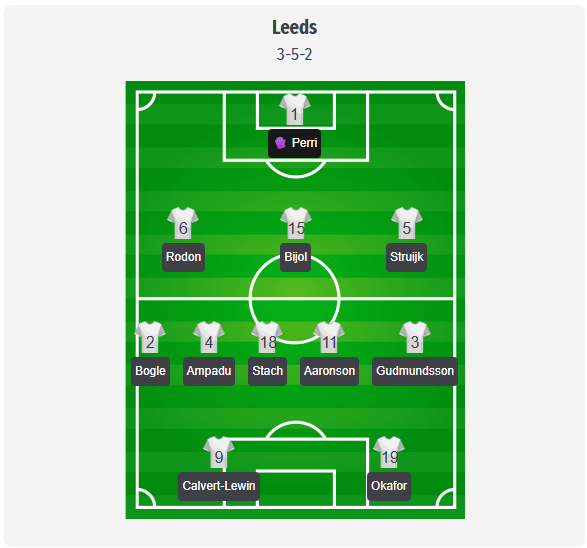
Leeds are expected to stick with Daniel Farke’s back five, so our predicted starting 11 retains the 3-5-2 that sparked their recent unbeaten league run. Perri is in goal behind a trio of Rodon, Bijol, and Struijk, with Bogle and Gudmundsson operating as wingbacks, Ampadu and Stach providing cover as defensive midfielders, Aaronson further forward, and Calvert-Lewin and Okafor as an energetic, vertical strike duo.
This formation would once again emphasize stability and danger from set pieces, with Calvert-Lewin’s goal-scoring streak and Aaronson’s recent creativity central to the offensive plan. Longstaff and James are expected to remain sidelined, and Nmecha is still out with a hamstring injury, so the predicted midfield of Ampadu, Stach, and Aaronson, with Calvert-Lewin and Okafor up front, seems a realistic, albeit tentative, scenario.
Liverpool – Leeds Head-to-Head & Statistics
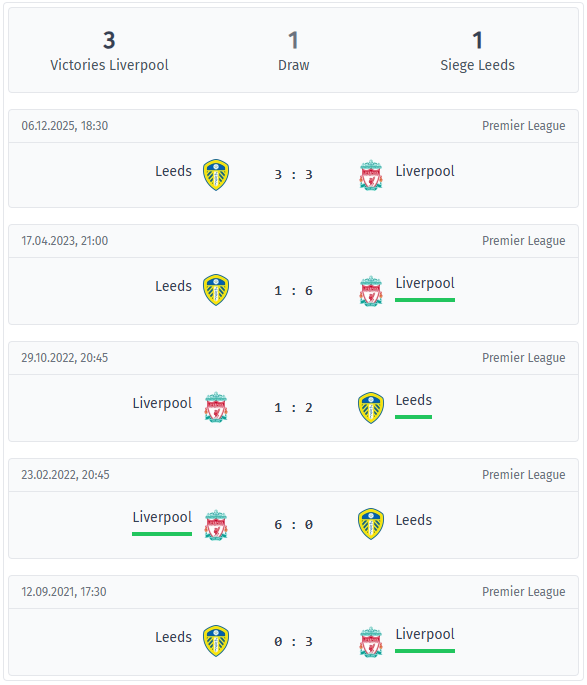
In the last five league meetings, Liverpool leads the mini-series with three wins, Leeds has recorded one win, and there has been one draw. The overall goal difference is striking, with Liverpool scoring 19 goals and Leeds scoring 6, averaging five goals per game. Each of these games ended with at least three goals, so history suggests an open encounter rather than a controlled, low-risk duel.
In 2021, Liverpool began this series with a 3-0 away win at Leeds, followed by a 6-0 win at Anfield in 2022, before suffering a 2-1 home defeat in the same year. In 2023, Liverpool responded with a 6-1 away win, and the 3-3 draw in December 2025 shows that Leeds has recently caught up significantly in terms of offensive strength. Liverpool scored in all five of these games, in four of them before halftime. Leeds conceded in every game, and the second halves were often chaotic, with at least two goals scored after the break in four of the five encounters, and three or more goals in the second half alone in the last three. In summary, the pattern is clear: Liverpool dominates the scoreboard, Leeds occasionally strikes back, and large fluctuations in momentum are common. For the next meeting at Anfield, recent history clearly points to a high-scoring game rather than a tactically cautious draw.