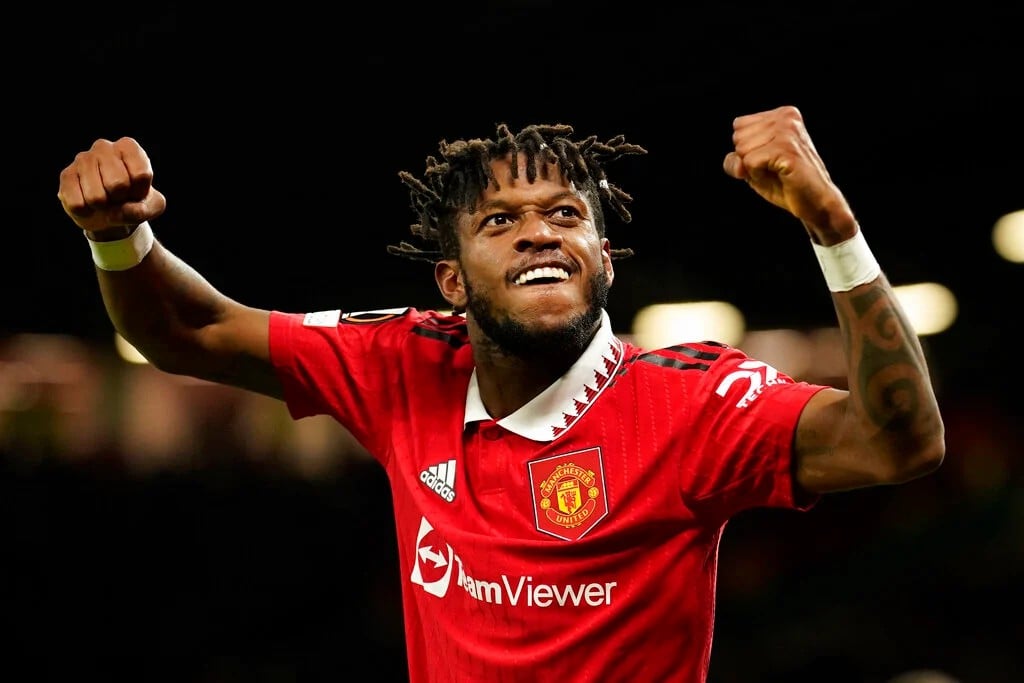
The worst start to a season in English league history meets a team that is quietly scratching at the Champions League places when Rúben Amorim’s Manchester United host bottom-of-the-table Wolverhampton Wanderers at Old Trafford on Matchday 19 of the Premier League. United are sixth with 29 points, buoyed by a narrow 1-0 Boxing Day win over Newcastle, while Rob Edwards’ Wolves arrive with just two points and a goal difference of minus 29, with analysts calling it the worst start to a season in English league history. The two sides met three weeks ago at Molineux, with United winning 4-1 to continue a run of clear results in which United have won three of the last five head-to-head matches and Wolverhampton the remaining two. However, Amorim’s squad has been noticeably depleted by injuries and Africa Cup of Nations call-ups, while Wolves showed more life despite their situation in Saturday’s 2-1 defeat at Liverpool. For United, it is an opportunity to increase the pressure in the battle for Champions League places. Their current sixth place is largely in line with pre-season predictions, and recent statistics rank them among the better-performing teams in Europe, with young defenders such as Heaven stabilizing an improvised defense. For Wolves, who were still considered contenders for a secure mid-table finish in August but are now predicted to finish bottom, every point would mean a lot in a grim relegation battle.
- Venue: Old Trafford, Manchester
- Date and time: December 30, 2025, 9:15 p.m.
- Competition: Premier League (Matchday 19)
With the betting market pricing a home win as the clear favorite at around 1.4, the approach is to bet on the improving structure at United under Amorim, which was evident in the clean sheet against Newcastle and the promotion of Heaven. This stability could be enough to comfortably overcome the bottom-of-the-table side, whose attack has lost confidence and continues to struggle to impress despite occasional flashes of brilliance from Arokodare.
Manchester United form & record check
After their Boxing Day victory against Newcastle in the 18th round, Manchester United’s league position is showing a slight upward trend. The team is in 6th place with 29 points, level on points with Chelsea and just ahead of Sunderland, exactly where expectations before the season saw them, more of a push for the top six than a real title challenge. Two wins, two draws, and one defeat from their last five league games suggest a team that is stabilizing rather than making a powerful charge. The latest results underscore this mixed picture: a 1-1 home draw against West Ham and a dominant 4-1 win at Wolverhampton were followed by a chaotic 4-4 draw against Bournemouth and a 2-1 defeat at Aston Villa, in which the defensive duels once again looked fragile, before the 1-0 Boxing Statistically, the picture fits: United have scored in each of their last five league games, usually in the first half, but at the same time, the team has conceded goals in most of these games, which keeps the matches open longer than Rúben Amorim would like. His tactical adjustments, switching between a back three and a 4-2-3-1, have improved the pressing at times, but sustained control after halftime has been lacking. Injuries and absences to Bruno Fernandes, Matthijs de Ligt, Noussair Mazraoui, Bryan Mbeumo, and Amad Diallo have stretched the squad, meaning that young players such as Ayden Heaven, Patrick Dorgu, and the inconsistent Leny Yoro have had to step up, while Zirkzee’s uncertain future adds an extra layer of uncertainty. A recent ranking based on goal difference placed United just outside the top 20 in Europe over the past two months, which fits with the impression given by their games: progress without complete authority. With the gaps in the league narrow, level on points with Chelsea and just ahead of Sunderland, the coming weeks will show whether this quiet upward trend is set to continue.
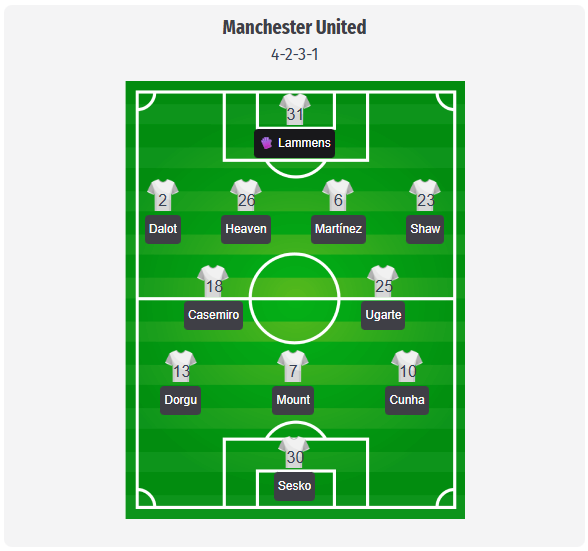
Manchester United are expected to stick with their now familiar 4-2-3-1 formation, with our predicted starting XI essentially based on the same team that beat Newcastle. Lammens is in goal, in front of him a back four of Dalot, Heaven, Martínez, and Shaw, Casemiro and Ugarte form the double six, with Dorgu, Mount, and Cunha supporting Sesko up front. This is still an expected lineup and not an official confirmation. Tactically, this prediction suggests a rather conservative defensive formation, with Casemiro providing cover and Ugarte pressing from deep, while Heaven pushes forward early to defend aggressively, something that Rúben Amorim has praised. Cunha is likely to cut inside from the right flank, leaving Dalot to cover the width, while Dorgu will tuck in from the left and work back to support Shaw in defensive duels on the flanks. Injuries continue to shape this expected starting lineup, with Matthijs de Ligt out injured and Noussair Mazraoui away at the Africa Cup of Nations, Heaven looks set to retain his place ahead of Yoro or Maguire. Further forward, Bruno Fernandes, Bryan Mbeumo, and Amad Diallo are missing, so Mount could once again take on the central creative role, with Cunha and Dorgu the main wing options and Zirkzee the most likely striker alternative from the bench.
Wolverhampton Form & Record Check
Wolverhampton travels to Old Trafford in historically poor league form. The team is bottom of the table with two points from eighteen games and a goal difference of minus 29, already ten points behind Burnley in 19th place. After last season’s recovery under Vitor Pereira and hopes ahead of this campaign that Rob Edwards could bring additional stability, statistical models now point to a Derby County-esque season that would be remembered for all the wrong reasons. The recent league record is brutal, with five consecutive defeats telling the story, even if the margins were often narrow. Wolverhampton lost 1-0 at home to Nottingham Forest and were taken apart 4-1 by Manchester United at the same stadium. The 2-1 defeats to Arsenal and Liverpool were closer, especially at Anfield, where Arokodare missed chances, while the rather bloodless 2-0 home defeat to Brentford looked tired for a team in trouble. The pattern behind these results is clear: in their last five league games, Wolves have never led at halftime, with four of those games tied at the break, yet they have lost each of those games. They have conceded goals in all five games, and in four of them the greater damage came after the break, fitting into a broader picture of fragile mentality and fitness, with concentration lapsing late and the negative goal difference of minus 29 threatening to grow further. Tactically, Edwards has pushed Wolverhampton to be more adventurous in possession, as was seen at Anfield, where late substitutions Strand Larsen and Arias pushed Liverpool back and a set piece from André eventually led to Buenos’ goal. This slightly more confident approach could signal a way out of the crisis, but without Agbadou, Doherty, and Chirewa, squad depth and conviction remain painfully thin.
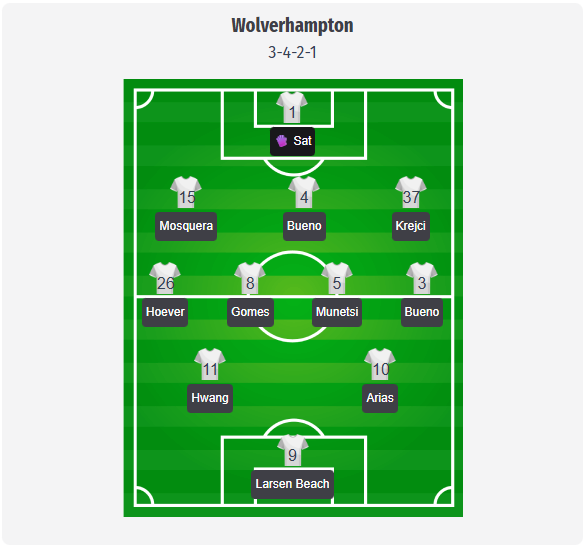
Our predicted starting lineup suggests that Wolverhampton are likely to stick with Rob Edwards’ 3-4-2-1 formation. Sa will be in goal behind a back three of Mosquera, Krejci, and Hoever, with one of the Buenos providing width on the flanks. In midfield, Gomes and Munetsi should stabilize the game, with Hwang and Arias likely to operate between the lines behind Strand Larsen, although Arokodare’s impact at Anfield could mean he retains the role of center forward. The predicted squad is missing Agbadou due to international duty, as well as winger Gomes and Doherty and Chirewa, who are all out, while Toti and Bentley are also not yet expected to return and Andre is suspended. This leaves the defense and wings looking thin, so players like Bellegarde, Lopez, and Gonzalez could once again cover multiple positions if Munetsi and Bellegarde’s recent problems in midfield limit their playing time.
Manchester United – Wolverhampton Head-to-Head Comparison & Statistics
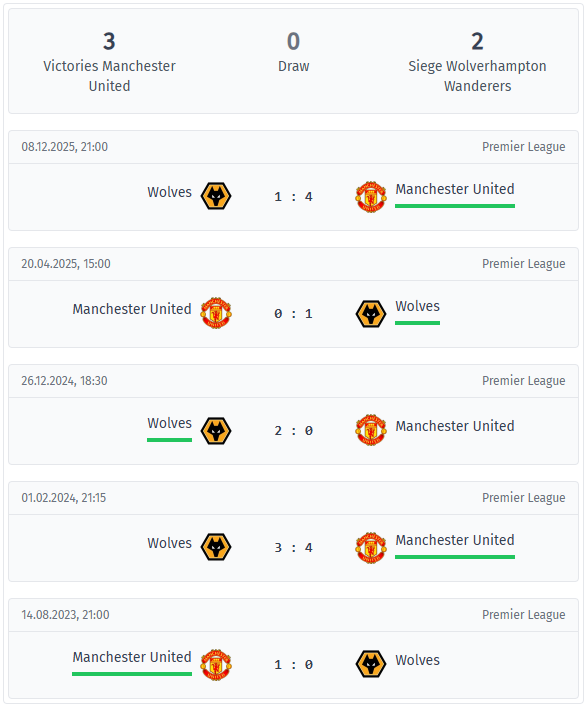
In the last five Premier League encounters, Manchester United have the slight edge, with three wins to Wolverhampton Wanderers’ two and no draws. This series came about in two distinct phases, with United winning the first two games, Wolverhampton responding with two wins in a row, and United striking back in December 2025. The games usually started cautiously and opened up after the break, with four of the five encounters level at halftime, but each time there was a winner in the end. A total of 16 goals were scored, an average of 3.2 per game, with Wolverhampton scoring in each of the last four encounters, while United conceded in four of the five games, so clean sheets are rare in this head-to-head comparison. Home and away patterns add another layer to the story, with the last two encounters at Old Trafford ending in draws, United narrowly winning in 2023 before Wolverhampton responded with a 1-0 victory in April 2025. The higher-scoring results came in Wolverhampton, where United won 4-3 in 2024 and 4-1 in December 2025, meaning their strongest performances in this fixture have so far come away from home. It is striking that Wolverhampton have never led at halftime in this series, even though the team won twice and scored in four consecutive games. Their influence was mostly evident after the break, suggesting a decline in concentration at United, even though United now feel as if they have reset the tone in this duel after their 4-1 win in December 2025.