The last home game of 2025 at the Ramón Sánchez Pizjuán feels like an early survival test for Sevilla, as Almeyda’s team goes into this direct duel at the bottom of the league on matchday 16 of La Liga in thirteenth place with 17 points against promoted Oviedo, who are nineteenth with 10 points. There is no established rivalry and no real history between the two clubs, with the tension arising almost exclusively from the league table situation and the question of who can give themselves some breathing space before the winter break.
Sevilla come into this game having taken only four of the last 21 possible points in the league, although the draw in Valencia and the recent cup win suggest at least some defensive stabilization with a more cautious approach. Oviedo, newly promoted and now under Luis Carrión, arrive on the back of a goalless draw with Mallorca, losing Cazorla and Viñas to suspension and Ejaria to injury, and continue to struggle to convert possession into goals. With Isaac and Peque suspended, more responsibility falls on Adams in attack, while Carrión, without Cazorla and Viñas, is likely to structure his team more around Reina, Hassan, and Rondón, which could give discipline and set pieces enormous weight in this tense duel at the bottom of the table.
- Venue: Estadio Ramón Sánchez Pizjuán, Seville
- Date and time: 14.12.2025, 14:00
- Competition: La Liga (matchday 16)
Sevilla will have to do without Romero and Vargas, while Oviedo will be without Cazorla and Viñas after five league games in a row without scoring, which is why Almeyda’s compact back three and Carrión’s safety-first approach suggest that the game will remain tight and low-scoring.
Sevilla form & record check
Sevilla go into this final home game of 2025 in a fragile league position. Thirteenth in the table with 17 points and a negative goal difference, they share the spoils with Rayo Vallecano and are only one point ahead of Real Sociedad. The table suggests mid-table, but the momentum clearly points to a relegation battle, as Almeyda’s team has picked up just four points from the last 21 available in the league.
In La Liga, they were unable to build on their 1-0 win over Osasuna, followed by a 2-1 defeat at Espanyol and a 2-0 derby debacle at home to Betis. The reaction was only partially positive, with a narrow 2-1 win at Extremadura in the Copa del Rey and a 1-1 draw away at Valencia calming nerves somewhat, even if the team continues to look anything but convincing.
There is a noticeable pattern in the course of the game: Sevilla usually start their matches in a controlled manner, but then slacken off considerably. In their last five games, they have not conceded a goal before half-time, and in four of those games, the first half ended in a draw, usually with few clear chances. After the break, things start to unravel, with four of those games ending with at least two goals scored. Sevilla scored in four of those games and also conceded four goals in the same period.
Almeyda has experimented with various solutions, such as a back three at Mestalla and young players like Castrín to support experienced players like Gudelj and Carmona. The constant changes are also due to injuries, with Nyland, Nianzou, Azpilicueta, and Vargas still out, while Suazo, Kike Salas, Juanlu, Ramón Martínez, and Januzaj are just returning to training. In attack, Adams’ frequent offside positions slow down the flow of the game, and the suspensions of Peque and Isaac Romero further limit the options.
Psychologically, the team continues to appear vulnerable. Hugo Duro’s late equalizer in the 90th minute at Mestalla is symbolic of a recurring problem: Sevilla struggle to manage the advantages they have worked hard to achieve. Interestingly, the energy seems to be better in the Copa matches against Toledo and Extremadura, where the pressure is different, while in the league every mistake weighs more heavily and the team too often retreats too close to its own penalty area.
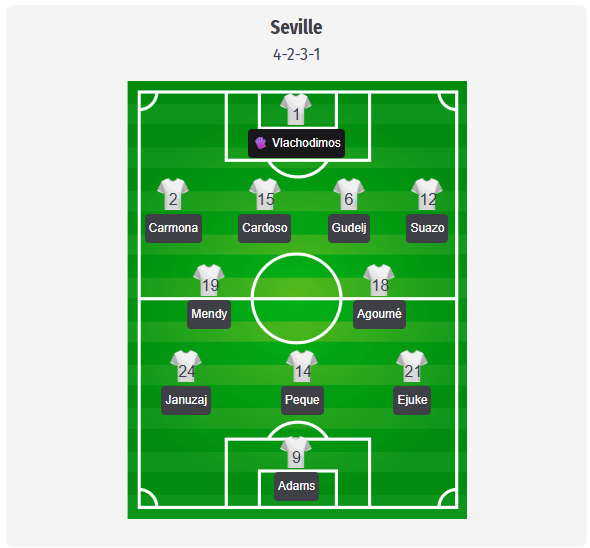
For the time being, Sevilla are likely to line up in the predicted 4-2-3-1 formation, with Vlachodimos in goal and a back four of Carmona, Cardoso, Gudelj, and Suazo, provided the Chilean gets the green light to start. Mendy and Agoumé are expected to provide balance in the double six, Januzaj and Ejuke will give the game width on the wings, and Adams will lead the attack, although after the experience at Mestalla, a late switch to three center backs cannot be ruled out.
Nyland, Marcão, Nianzou, Azpilicueta, and Vargas are still out, which means Almeyda has little room to rotate in defense or on the wings, and Romero and Fernández are also suspended. Suazo, Salas, and Januzaj have only just returned to training, so their playing time is likely to be limited, with González or Sánchez coming into contention as substitutes to make an impact from the bench.
Oviedo Form & Record Check
Oviedo reaches this point in La Liga at a particularly delicate moment. Nineteenth in the table with 10 points and a goal difference of minus 15, they are sandwiched between Girona just above them, two points away, and Levante just below them, one point away. This table reflects a run of five games without a win and a team that lacks conviction.
Recent performances at the Carlos Tartiere tell this story quite clearly. Three consecutive 0-0 draws against Osasuna, Rayo Vallecano, and Mallorca show a well-organized defensive block that controls long periods of the game, but the team struggles to create clear chances and push forward with enough presence from midfield, leaving the striker often without real support and rarely putting serious pressure on their opponents.
Away from home, the picture is even bleaker. They lost 1-0 at Athletic Club and 2-0 at Atletico Madrid, games in which early goals forced them into a frantic chase without any clear structure. Statistically, this underscores an offensive blockage: Oviedo has gone five league games in a row without scoring, and each of these matches ended with a maximum of 2.5 goals, with the second halves always remaining balanced and ending without a single goal for or against the team.
Since his arrival, Carrión has tightened up the team defensively, the structure seems more stable and explains the clean sheets at home, but they are paying for this progress in the final third of the field. One might think that the fear of losing the ball is now too great, with strikers such as Rondón and Álex Forés receiving few passes and often finding themselves isolated against well-organized defenses.
The personnel problems are getting worse. Cazorla and Viñas are suspended after the tense draw against Mallorca, Ejaria is out until the winter break and Ilic is doubtful, which means Carrión loses a lot of creativity between the lines. On the right wing, the suspended Viñas leaves a gap that Hassan and Brekalo are fighting over, while the long-term absence of Lemos further limits the options at full-back.
On top of that, discipline has become a real handicap. Oviedo has already seen six red cards this season, more than any other team in the league, with sendings-off for Reina, Ilic, Chaira, Viñas, and now Cazorla. Time and again, games are ended with only ten men, which destroys rhythm and costs points, even if Cazorla’s public apology at least showed that the dressing room wants to stick together.
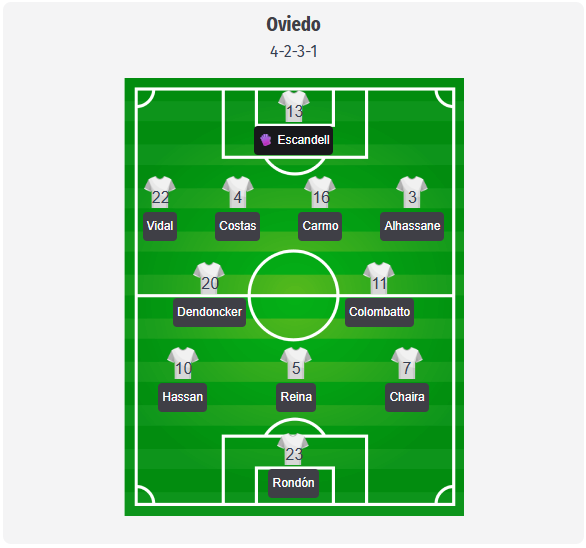
Oviedo are likely to stick with their usual 4-2-3-1 formation, with Escandell in goal and a back four of Vidal, Costas, Carmo, and Alhassane in our projection. Dendoncker and Colombatto would form the double six to secure the center and play the first pass, with Reina, Chaira, and Hassan Rondón supporting them up front, who is likely to once again serve as the reference point in attack.
The absences of Cazorla and Viñas due to suspensions, plus Ejaria’s muscle problems and the question mark over Ilic, leave Carrión short in the final third, so our predicted starting eleven remains a 4-2-3-1 with Reina as the central playmaker and Hassan on the right. Lemos remains sidelined on the right side of defense, confirming Vidal as the starter, while Brekalo can be considered the most important alternative off the bench.
Sevilla – Oviedo Head-to-head & Statistics
Sevilla and Oviedo have never met in an official match, so there is no head-to-head record between the two clubs. Accordingly, there is no historical data on wins, draws, goal differences, or typical game patterns that would otherwise be used to classify a duel.
Without previous encounters, neither recurring tactical patterns nor psychological advantages or statistical dominance of one side can be proven; any narrative of historical superiority would not be supported by facts. Interestingly, this league match therefore starts without any statistical history, so a serious preview must be based on current form, playing style, and squad situation rather than on a shared past that simply does not exist.