When bottom-of-the-table Wolverhampton, who have lost five competitive games in a row and failed to score in their last four, face Nottingham Forest, this Premier League clash initially looks like a meeting between two teams in crisis, but the omens are clear. Wolverhampton are bottom of the table with just two points from 13 games, lacking any threat in attack and vulnerable at the back, as evidenced by the nine goals they have conceded in these four goalless games. Nottingham Forest are in 16th place with twelve points, but also showed clear weaknesses in their recent 2-0 defeat to Brighton and are far from being confident. A direct comparison of the last five matches favors Forest, with Wolves failing to win, four draws and one win for Forest. It is striking that at least two goals were scored in all five encounters and Forest led at half-time in each case, which could give the visitors a slight mental advantage. Wolves are still without Hoever and Doherty, and Rodrigo Gomes is also out for the long term, which means that coach Rob Edwards has limited options for changes. Forest are likely to have Morgan Gibbs-White and Murillo back, both of whom had minor problems recently but are considered fit to play. From a tactical point of view, Wolverhampton urgently needs more offensive impetus and, at the same time, more stability in defense, so Edwards is likely to play it safe in order to avoid conceding further goals. Forest, under Sean Dyche, is defensively organized and looks for its chances mainly on the counterattack and from set pieces, which suits Wolverhampton’s current weakness in front of goal. Given the form of the two teams, Nottingham are slight favorites, and a narrow away win or a draw with few clear-cut chances seems realistic.
- Venue: Molineux Stadium, Wolverhampton
- Date and time: 03.12.2025, 8:30 p.m.
- Competition: Premier League (Matchday 14)
Nottingham Forest travels to Molineux with significant momentum, with three consecutive wins, including a 3-0 victory at Liverpool, bringing confidence and structure. Wolverhampton has been winless since April, has not scored in its last four league games, and is in an extremely weak position with only two points from 13 games. The difference in form is the key factor for any prediction. Tip 1 as the main bet is Forest to win, buoyed by their current form, a more stable defense under Sean Dyche, and the Wolves’ offensive slump, who have gone four league games without scoring. Against this backdrop, bookmaker odds of around 2.3 seem attractive, and the risk remains moderate because, although an away win in Wolverhampton is never guaranteed, the probability appears to be clearly increased by the starting position. Tip 2, as a more conservative option, is Forest to win or draw (1X). This option significantly reduces the risk because even on a weaker day, Wolverhampton is likely to lack the offensive quality to score consistently. This bet is particularly suitable for more cautious betting strategies. Tip 3 is a higher-risk option with correspondingly higher odds: Forest wins to nil. This is based on Wolverhampton’s ongoing goal drought over four games and Forest’s improved organization, but the stake should be deliberately lower here. Important for all bets: Forest’s key players Morgan Gibbs-White and Murillo are expected to be available, with Gibbs-White scoring 4 goals in 6 games under Dyche, while Wolves will be without Rodrigo Gomes, among others.
Wolverhampton Form & Record Check
Wolverhampton are in 20th place in the table with only two points after 13 games and are already eight points behind 19th place. They have lost five league games in a row, conceding goals in all of them. Only in their most recent game did they manage to score a goal of their own, meaning that their offense is effectively ineffective and their defense collapses too often, especially after the break. Under new coach Rob Edwards, there was at least a slight improvement in intensity and presence against Aston Villa. Chances such as Strand Larsen’s goal, which was disallowed for offside, and Mosquera’s shot against the crossbar indicate that there are signs of improvement, but overall the offensive play is still not enough, and especially in the first half, there is a lack of clear chances and goals. Defensively, there is a recurring pattern of the team losing its organization and concentration in the second half, which leads to late goals conceded. In terms of personnel, important players such as Hoever, Doherty, and Rodrigo Gomes are missing for the long term, and the new technical director Jackson has already criticized the squad planning as flawed, with good sales but too few new signings who are immediately available for selection. Manchester United’s interest in João Gomes is causing additional unrest, and in December, the Africa Cup of Nations threatens to cause further personnel losses, with up to five players, including Tchatchoua, Agbadou, and Arokodare, potentially missing. In the short term, it makes sense to focus on simple, robust playing systems, for example with a more compact midfield and earlier substitutions to compensate for fatigue after the break. In addition, set pieces should be trained intensively, both defensively and offensively. In the transfer market, loans of players who are ready to play immediately could provide short-term relief, but in the medium term, squad planning needs to be readjusted, with a better balance between sales proceeds and targeted investments in professionals who can help immediately. In addition, management should more actively moderate speculation such as that surrounding João Gomes in order to minimize internal unrest. The situation is serious, but not hopeless. With quick, pragmatic adjustments to tactics, personnel structure, and transfer strategy, Wolverhampton can at least mitigate the risk of relegation.
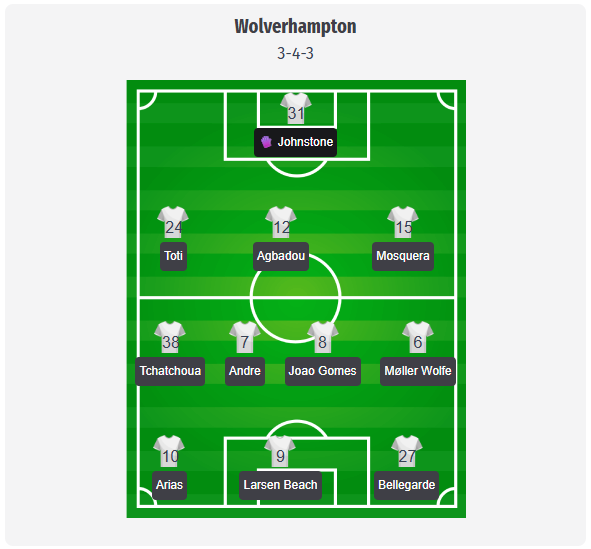
Rob Edwards is expected to stick with a 3-4-3 system against Nottingham Forest, with Johnstone in goal and a back three of Toti, Agbadou, and Mosquera in front of him. Tchatchoua, on the left or right as needed, and Møller Wolfe are expected to play on the wings, while Andre and João Gomes are likely to close down space and build up play in central midfield. Arias, Strand Larsen, and Bellegarde are the most likely starters in attack and will be expected to provide a goal threat despite their ongoing slump. Hoever and Doherty are still missing in defense, and the long-term absence of Rodrigo Gomes in attacking midfield is particularly significant, with his return not expected until February. Given the team’s very poor form, with only two points from 13 games, few tactical experiments are to be expected, but the above lineup remains a prediction and must be considered speculative until the official team lineup is announced.
Nottingham Form & Record Check
Nottingham Forest is going through a fluctuating phase. The 3-0 win in Liverpool showed discipline, defensive stability, and a clear game plan, but the subsequent 0-2 defeat to Brighton once again exposed a lack of ideas and punch. The defense remains fragile, even though Sean Dyche is gradually making his mark. They have 12 points from 13 games and are in 16th place, just one point ahead of West Ham and five points behind Fulham. The situation is tense, and consistency is key to avoid being dragged deeper into the relegation battle. Several injuries are weighing on the squad, with Zinchenko, Douglas Luiz, Bakwa, Wood, and Awoniyi all out. Aina is not expected back until January, but at least Murillo and Gibbs-White could return against Wolves, which gives Dyche a little more leeway. Overall, however, the options remain limited, especially in midfield and attack. Tactically, Dyche needs to further stabilize the defense, defend set pieces better, and ensure orderly offensive moments. Against Liverpool, this worked with high discipline and good transition movements, but against Brighton, this very punch was missing. Gibbs-White is a key player as a central playmaker, while Kalimuendo and Wood are expected to play important roles in the attack as targets in the penalty area. The course of the season so far, with the double burden of European Cup and league play, is risky. Forest should set clear priorities in favor of the Premier League in the short term in order to avoid serious relegation problems. The victory at Anfield Road is encouraging, but so far it is more of a snapshot. The decisive factor will be whether Dyche can build on it with a winning streak. It would make sense to set some clear priorities, train defensive compactness and set pieces intensively, consistently use Gibbs-White in the center, manage rotation very carefully given the thin squad, and rely on simple, clear game ideas in the event of major personnel losses, such as counterattacks and crosses to the strikers.
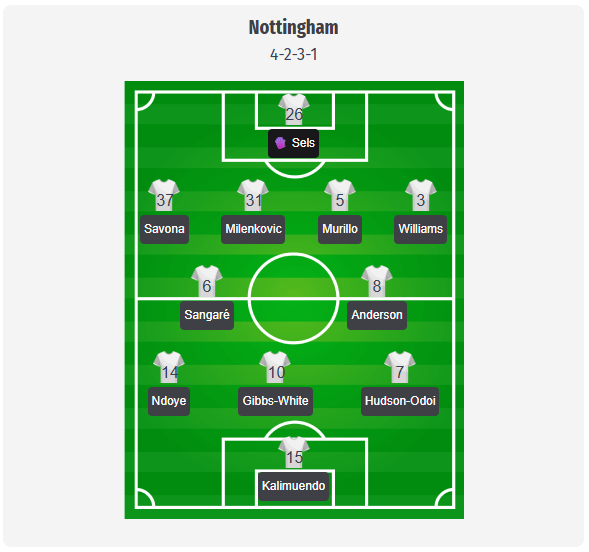
Nottingham Forest are likely to line up in a 4-2-3-1 formation, the basic system with which coach Sean Dyche has recently secured three consecutive victories. Murillo and Gibbs-White are expected to be fit again after minor injuries, with Dyche having rested both players as a precautionary measure in order to avoid taking any additional risks. Several players are missing from the Europa League squad for disciplinary or registration reasons, with Awoniyi, Hutchinson, and Gunn not included. In addition, Douglas Luiz is out with thigh problems and Zinchenko with a groin injury. Kalimuendo could be the lone striker up front, with Ndoye, Gibbs-White, and Hudson-Odoi expected to form the nominal attacking trio behind him.
Wolverhampton – Nottingham Head-to-head comparison & statistics
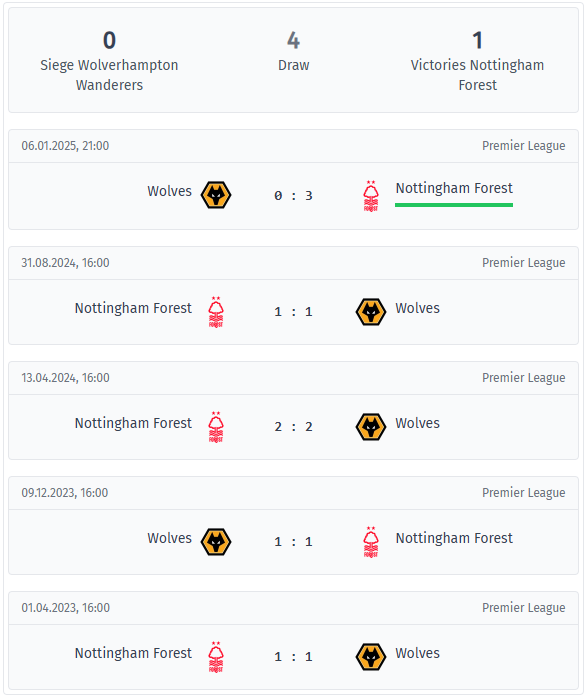
In the last five direct duels between Wolverhampton and Nottingham Forest, there has been one win for Forest, a 3-0 victory in January 2025 at Molineux, and four draws, including a 1-1 draw in August 2024 and a 2-2 draw in April 2024. Nottingham Forest scored in all five games and took the lead in the first half in each case, meaning that Wolverhampton conceded at least one goal before the break in each of these games, which suggests a particular vulnerability in the early stages against this opponent. The hosts also scored in four of the five encounters. At least two goals were scored in all of the matches, with only one game seeing more than three goals scored. Overall, the head-to-head record shows a recurring pattern of high-scoring but rarely completely open games.